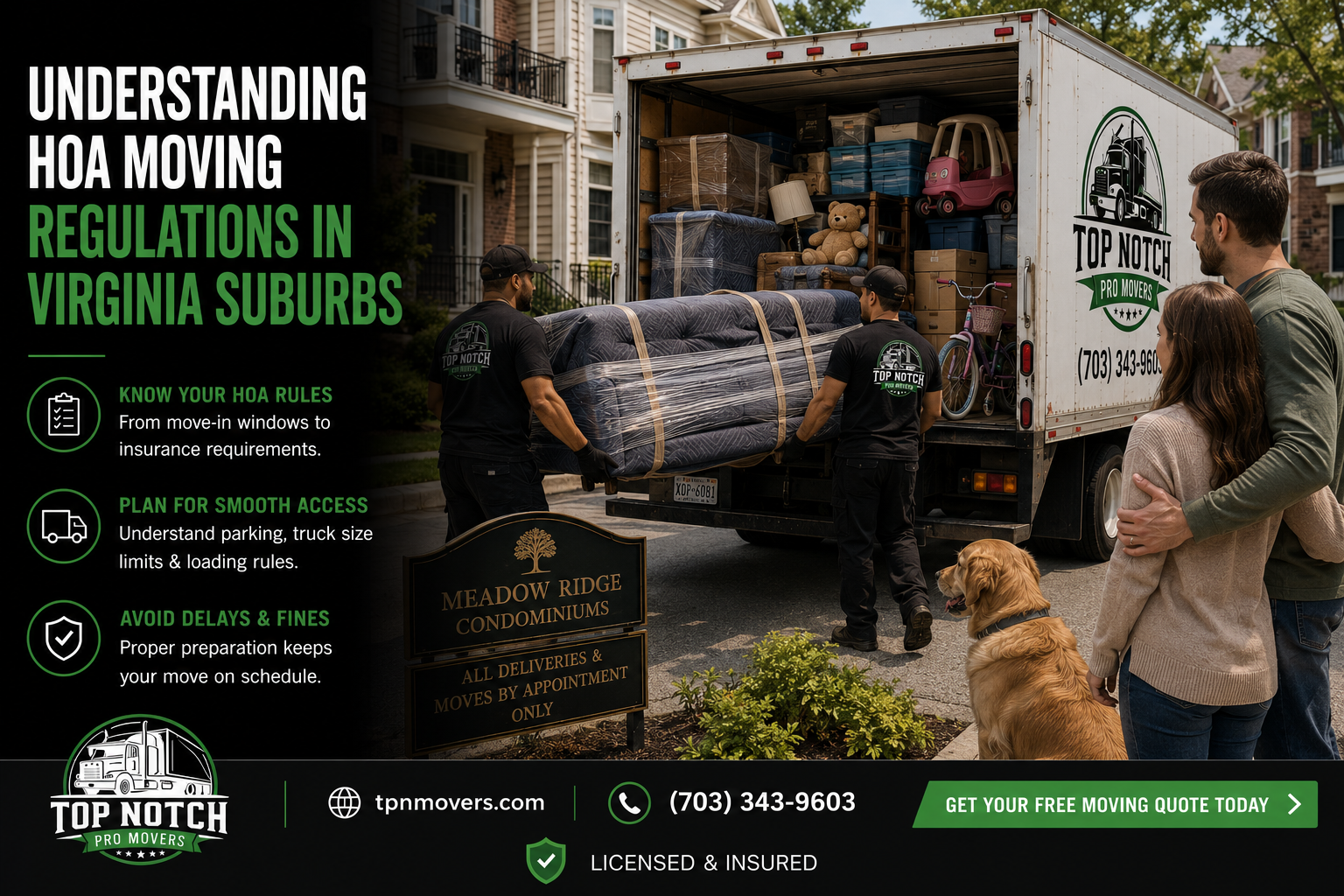

Anyone who has moved into a high-rise in Rosslyn or a townhouse community in Fairfax knows that the truck showing up on time is only half the job. The other half is paperwork, and in Northern Virginia, that paperwork can make or break a move-in day. Condo boards and homeowners associations across Arlington, Alexandria, Fairfax, and Loudoun County have grown increasingly strict about how, when, and under what conditions a move can happen inside their buildings and communities.
This matters more than most people expect. Whether someone is hiring a local moving company in Virginia for a short move across town, bringing in a commercial moving company in Virginia to relocate an office into a mixed-use tower, or coordinating long distance moving in Virginia from another state, the building’s rules apply regardless of the distance traveled or the size of the shipment. Movers such as Top Notch Pro Movers run into these building-specific requirements on a near-daily basis, and a perfectly planned move can still stall in the lobby if a certificate of insurance wasn’t filed or an elevator wasn’t reserved.
Why Condo and HOA Rules Exist in the First Place
Boards aren’t writing these policies to be difficult. Shared hallways, single freight elevators, and common-area finishes are expensive to repair, and one careless move can damage flooring, walls, or door frames that hundreds of residents rely on. Insurance carriers for these buildings also require documentation of who is doing the work and what coverage they carry, since a dropped piece of furniture or a scraped elevator wall becomes a liability claim the building has to sort out.
Common Rules Across Northern Virginia Buildings
While every association writes its own rulebook, a few requirements show up again and again in Arlington, Alexandria, and Tysons-area buildings: a Certificate of Insurance (COI) from the moving company, often naming the building as an additional insured; advance elevator or loading dock reservations, frequently requiring three business days’ notice; defined move windows, usually limited to weekdays and excluding evenings or weekends; refundable move-in or move-out deposits, sometimes running several hundred dollars; padding requirements for elevator interiors and hallway corners; and a signed acknowledgment form confirming the resident has read the community’s move-in rules.
Local Government Requirements Layered on Top of Building Rules
Building policies are only one layer. Local jurisdictions add their own requirements for moving trucks parked on public streets. Arlington requires a moving van permit filed at least three business days in advance, and it typically allows up to two consecutive days of curb space. Alexandria follows a similar pattern, with reservations generally needing to be submitted by noon, three business days before the move.
Comparing Condo Fees Across Northern Virginia
Move-in logistics aside, the ongoing cost of condo living varies widely by building type and location. The table below gives a general sense of what residents typically pay.
| Building Type | Typical Monthly Fee | What It Usually Covers |
|---|---|---|
| Garden-style condos (Falls Church area) | $150 – $400 | Basic exterior maintenance, limited amenities |
| Mid- to high-rise condos near transit corridors | $400 – $1,200+ | Doorman, elevators, garage parking, master insurance |
| Townhome HOAs (Fairfax, Falls Church) | $100 – $450 | Exterior upkeep, snow removal, common areas |
| Single-family HOA communities | $70 – $200 | Landscaping, private streets, community amenities |
Actual figures depend heavily on building age, reserve fund health, and how many amenities are attached to the property, so residents should always confirm exact numbers in the association’s disclosure documents rather than relying on general averages.
Typical Move-In Requirements by Community Type
| Requirement | High-Rise Condo | Mid-Rise Condo | Townhouse HOA |
|---|---|---|---|
| Certificate of Insurance | Almost always required | Usually required | Rarely required |
| Elevator reservation | Required, 3+ days notice | Often required | Not applicable |
| Move-in deposit | Common, $150–$500 | Sometimes | Uncommon |
| Time window restrictions | Strict, weekday hours | Moderate | Minimal |
| Loading dock booking | Common in newer towers | Occasional | Not applicable |
What Happens When the Rules Are Ignored
Skipping a required COI or elevator booking rarely ends with a warning. Building management can turn a crew away at the door, and Top Notch Pro Movers has seen firsthand how a missed reservation on move day can push an entire schedule back by hours, sometimes forcing a family to spend an unplanned night in a hotel while boxes sit on the truck. Fines for unauthorized moves or damage to common areas can also be billed directly to the resident, separate from any charge assessed to the moving company.
Statistics Worth Knowing Before Moving Day
Northern Virginia’s housing market context helps explain why these rules have tightened over the years. The median home sale price across the region reached roughly $664,000 in mid-2025, and rental costs have climbed alongside it, with Arlington one-bedroom apartments averaging around $2,405 a month. As more residents move into higher-density condo towers rather than single-family homes, buildings have had to formalize move-in procedures simply to manage the volume of turnover happening in shared spaces.
Practical Tips Before Move Day
Confirm building requirements at least two weeks ahead, not two days. Request the COI from the mover as early as possible, since insurance departments can take time to issue a certificate naming a specific building as additional insured. Ask the property manager directly whether a deposit is refundable and how quickly it’s returned after move-out inspection. It’s also worth asking whether the building restricts move times to weekdays only, since many Northern Virginia associations exclude Saturdays and Sundays entirely.
Frequently Asked Questions
Do all condo buildings in Northern Virginia require a Certificate of Insurance?
Most professionally managed buildings do, particularly high-rises with shared elevators and loading docks. Smaller or self-managed buildings may not enforce this as strictly, but it’s worth confirming directly with the property manager rather than assuming either way.
How far in advance should an elevator or loading dock be reserved?
Many buildings ask for at least three business days’ notice, and some popular buildings in Arlington and Alexandria fill their move slots quickly, so booking two to three weeks ahead is safer for weekend or month-end dates.
Are HOA move-in deposits refundable?
In most cases, yes, provided there’s no damage to common areas during the move. The refund timeline varies by association, ranging from immediate to several weeks after a post-move inspection.
Can an HOA or condo board deny a move-in request entirely?
Associations generally cannot deny a legitimate resident’s right to move in, but they can enforce scheduling windows, documentation requirements, and fees. Ignoring those requirements is what typically leads to a denied or delayed move.
Do these rules apply to office or commercial relocations in mixed-use buildings?
Yes. Mixed-use towers with residential and commercial tenants often apply the same COI, loading dock, and time-window rules to business moves as they do to residential ones, sometimes with added freight elevator restrictions during business hours.
Final Thoughts
Condo and HOA moving rules in Northern Virginia aren’t designed to slow anyone down, but they do reward preparation. Reading the building’s move-in packet early, lining up insurance documentation, and confirming reservations well before the truck arrives are the details that separate a smooth move-in day from a frustrating one. Top Notch Pro Movers has found that the residents who ask their building’s front desk the right questions early tend to have the calmest move days, regardless of which floor they’re moving to. For anyone weighing options, comparing a local moving company in Virginia, a commercial moving company in Virginia, or long-distance moving in Virginia service against a building’s specific requirements ahead of time remains the single best way to avoid a stalled move-in day. Top Notch Pro Movers continues to see this preparation gap as the most common — and most avoidable — cause of move-day delays across the region.