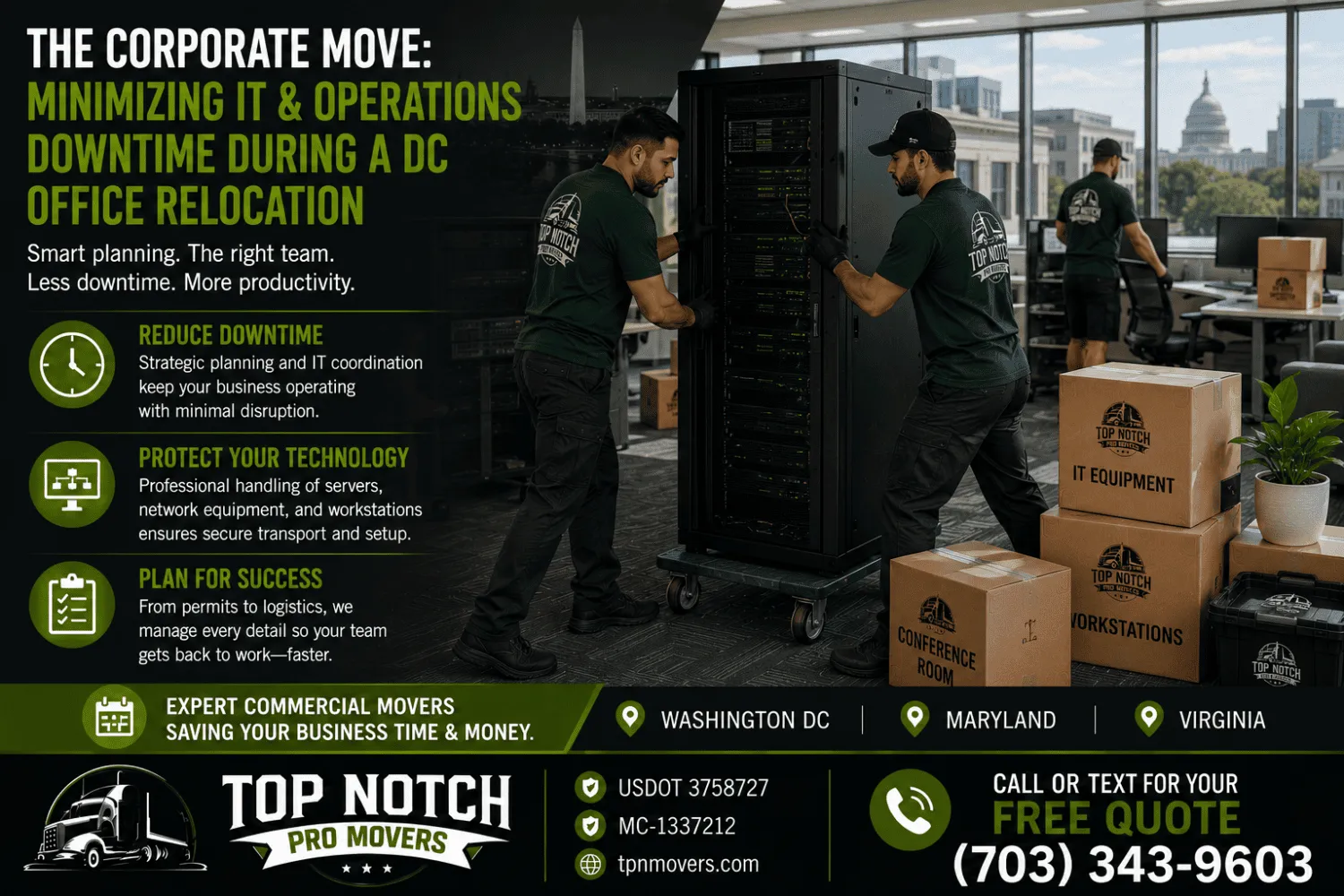


Relocating within or across the Washington, D.C., Maryland, and Virginia corridor is one of the most logistically demanding moves a household or business can undertake. The DMV area sits at the intersection of three distinct jurisdictions, each operating under its own parking codes, permitting requirements, and municipal rules. What you do not know on move day can cost you real money in citations and delays.
Whether you are working with a local moving company in DMV, planning a cross-state transition with long distance movers in DMV, or coordinating an office relocation through commercial movers in DMV, understanding moving permits and parking restrictions before day one is not optional. It is the foundation of a move that runs on time.
This guide breaks down the permitting landscape across DC, Maryland, and Virginia so you walk into your move with a clear plan. If you need a team that already knows this terrain, Top Notch Movers has been handling DMV moves and all their permit logistics for years.
Quick Navigation:
- Local moving company in DMV — permits for residential moves within the metro area
- Long Distance Movers in DMV — interstate permit rules and FMCSA obligations
- Commercial movers in DMV — building permits, loading dock access, and HOA rules
Why Moving Permits Matter More in the DMV Than Almost Anywhere Else
The DMV region is unique in the United States. Three jurisdictions share geography but operate independently. A move that starts in Stafford, Virginia and ends in Silver Spring, Maryland technically crosses two state lines and passes through federal territory. That geographic reality creates a permitting environment where the rules change block by block.
According to the most recent U.S. Census data, an estimated 40.1 million adults moved in 2024 alone. The moving industry generated $23.1 billion in revenue that same year, representing an 8.4 percent increase from the prior year. Within the DMV specifically, federal employment patterns continue to drive relocation activity, though recent federal workforce reductions have also accelerated outbound moves from the D.C. core.
Failing to secure a moving permit in D.C. does not just mean a ticket. It means your truck may be towed, your move is delayed by hours, and your movers are billing you for time they cannot use. In a region where parking on a city block can be fiercely competitive, arriving without a reserved space is a gamble most households cannot afford to take.
Washington, D.C.: The Temporary Occupancy Permit System
The District of Columbia operates one of the most structured moving permit systems on the East Coast. The District Department of Transportation (DDOT) manages street-level parking through its Temporary Occupancy Permit System (TOPS). Any household or business moving into or out of a D.C. address that requires street parking for a truck must apply through this portal.
How the TOPS Process Works
- Create an account on the DDOT TOPS portal at tops.ddot.dc.gov
- Select Parking/Occupancy Permit and choose Moving Truck as the permit type
- Enter your move address and the date and time window you need (up to two full days)
- Pay the permit fee of approximately $55 per reserved space
- Post the issued No Parking signs at least 72 hours before your move in non-metered areas, or 24 hours in metered zones
A single $55 permit reserves up to 88 feet of curb space, which covers most standard moving trucks. Larger vehicles, such as a 26-foot truck, may require an additional permit. Applying at least two weeks in advance is strongly recommended, as popular moving dates fill up quickly, particularly around end-of-month cycles and peak summer months.
Virginia: A Jurisdiction-by-Jurisdiction Breakdown
Virginia does not operate a single statewide moving permit system. Permit requirements vary by city and county, and in many suburban neighborhoods, no permit is needed at all. That said, knowing the specific rules for your locality is still critical.
Key Virginia localities and their parking rules for moving trucks:
- Reston: Moving trucks may park in residential areas for up to 48 hours without a permit, provided they do not block traffic flow.
- Falls Church: Service vehicles may park without a permit for up to 8 hours within a 24-hour period. Beyond that threshold, contact the Falls Church Police Department at 703-241-5053.
- Arlington: Rules vary by block and zone. Contact Arlington County DES before scheduling your move to confirm whether a curb reservation is needed.
Maryland: City Offices and Meter Bagging Requirements
Maryland follows a similar decentralized model to Virginia, with each municipality setting its own moving permit rules. A few key jurisdictions require advance coordination.
- Rockville: Moving trucks operating in non-Residential Permit Parking zones need no permit. In RPP zones, a permit is required. Metered spaces require feeding the meter for the duration of the move.
- Silver Spring: Meter bagging requests must be submitted to Montgomery County DOT at 240-777-8740 at least one week in advance.
- Gaithersburg: Contact the Department of Public Works at publicworks@gaithersburgmd.gov or 301-258-6370 to obtain No Parking signs.
- Frederick: No Parking signs are issued through the Parking Department at 2 South Court Street or by calling 301-600-1429.
- Leesburg: Downtown parking meter bags cost $10 per day per space and are required for loading zones when trucks need more than two hours.
DMV Moving Permit Quick Reference by Jurisdiction
Use this table as a starting reference. Always verify current rules directly with the relevant city or county office before your move date.
| Jurisdiction | Permit Required? | Advance Notice | Approx. Fee |
| Washington, D.C. | Yes (TOP via DDOT) | 72 hrs (non-metered) / 24 hrs (metered) | $55 per space |
| Arlington, VA | Case-by-case | 48 hrs recommended | Varies by zone |
| Falls Church, VA | Only if 8+ hrs | Prior day notice | Call PD for approval |
| Reston, VA | No (up to 48 hrs) | N/A | Free |
| Rockville, MD | Only if RPP zone | 48 hrs recommended | Varies |
| Silver Spring, MD | Meter bagging needed | 1 week in advance | Contact MCDOT |
| Gaithersburg, MD | Yes (No-Parking signs) | Contact DPW | Contact City |
| Frederick, MD | Yes (No-Parking signs) | Contact Parking Dept. | Contact City |
Move Type Matters: Local, Long Distance, and Commercial
Not every DMV move carries the same permit burden. The type of relocation you are executing has a direct impact on how many jurisdictions are involved and how far in advance your permit planning needs to begin.
| Move Type | Typical Permit Need | Timeline to Secure | Key Contacts |
| Local (Same City) | Likely none or minimal | 1-3 business days | City parking office |
| Local (Cross-Jurisdiction) | May need permits in each city | 3-5 business days | Each city/county office |
| Long Distance (Interstate) | Both origin and destination | 1-2 weeks minimum | FMCSA + local offices |
| Commercial / Office | Almost always required | 2-4 weeks minimum | Building mgmt + city |
For local moves within a single city, permit requirements are often minimal or nonexistent in residential zones. Cross-jurisdiction local moves introduce the complication of two separate city permit offices, each with its own timeline and contact process.
Long distance moves that cross state lines trigger federal oversight in addition to local rules. The Federal Motor Carrier Safety Administration (FMCSA) requires interstate movers to provide customers with the booklet Your Rights and Responsibilities When You Move. Retaining a copy alongside your bill of lading and moving estimate is a sound practice that protects you if a dispute arises.
Commercial relocations are typically the most permit-intensive category. Office buildings in D.C. and major Virginia and Maryland cities often have their own internal loading dock reservation systems, building management requirements for certificate of insurance, and elevator booking windows that operate independently of any city-level permit. Coordinate with your building manager at least three to four weeks before your target move date.
Apartment and Condo Moves: The Building Management Layer
A moving permit from the city only resolves the street-side piece of your logistics. If you are moving into or out of an apartment building or condominium, you face a second layer of coordination with building management that is entirely separate from municipal government.
Most mid-rise and high-rise buildings in D.C., Arlington, and Bethesda require residents to reserve the freight elevator at least 48 to 72 hours in advance. Many buildings also require proof of insurance from the moving company before granting access. In some cases, a refundable deposit is required to cover potential damage to common areas. Top Notch Movers carries the documentation necessary for these requirements and works directly with building managers to confirm access windows before move day.
Missing an elevator reservation in a building with a single freight elevator means your crew waits while the clock runs. On an hourly contract, that time comes directly out of your budget.
Practical Tips for a Permit-Ready Move in the DMV
- Confirm permit requirements at least two to three weeks before your move date, not two to three days.
- Target a weekday move over a weekend whenever possible. D.C. street cleaning schedules and weekend events regularly create additional parking conflicts.
- Post No Parking signs early. Enforcement of your reservation depends on those signs being visible to the public before your move window opens.
- Keep copies of all permits, receipts, and correspondence with city offices in a single folder. If your truck is cited, documentation is your fastest path to resolution.
- Verify that your moving company is licensed and insured under the requirements of each jurisdiction involved in your move.
- For high-density urban blocks, consider scheduling your move to start before 8:00 AM when parking competition is lower.
What Happens If You Skip the Permit?
Moving without the required permits in D.C. or a Maryland city that mandates them is not a minor inconvenience. Citations in Washington, D.C. for unauthorized use of a curb lane or blocking a marked zone can result in fines starting at $100 and escalating with each violation. Towing fees in D.C. typically run $100 or more for the initial pull, plus $35 per day in storage until the vehicle is retrieved.
Beyond the financial hit, a towed truck means a halted move. If you are on an hourly contract, every minute the crew stands idle waiting for a truck to be recovered is billed against you. The cost of that disruption almost always exceeds the cost of obtaining the permit in the first place. Top Notch Movers incorporates permit verification into its pre-move planning process precisely because the downside of skipping it is too significant.
Working With a Mover Who Knows the DMV Permit Landscape
One of the clearest advantages of hiring an established DMV moving company over a national franchise or an independent crew is institutional knowledge of local permitting requirements. A team that has executed hundreds of moves across Stafford, Fredericksburg, Arlington, D.C., and Montgomery County has already worked through the permit systems for each locality. They know who to call, how far in advance to call them, and what documentation each office needs.
Top Notch Movers brings that institutional knowledge to every job. Whether you are relocating a two-bedroom apartment from Columbia Heights to Rockville or moving a corporate office from Tysons Corner to downtown D.C., the permit and parking coordination happens in the background so your focus can remain on the move itself.
In a region as complex and fast-moving as the DMV, working with a mover who treats permit management as a standard part of the process is not a luxury. It is the difference between a move that closes on schedule and one that turns into an expensive, all-day ordeal on the sidewalk.
Frequently Asked Questions
1. Do I need a moving permit for every city in the DMV?
No. Permit requirements vary significantly by jurisdiction. Washington, D.C. requires a Temporary Occupancy Permit for street parking in virtually all areas. Many Virginia suburbs like Reston do not require permits at all for residential moves under 48 hours. Maryland cities such as Silver Spring and Gaithersburg require advance coordination for meter bagging or No Parking signs. Always check with the specific city or county office where you are moving before assuming no permit is needed.
2. How far in advance should I apply for a DC moving permit?
Apply at least two weeks before your move date. The DDOT TOPS portal processes applications and issues permits that must be physically posted at least 72 hours before the move in non-metered zones, or 24 hours before in metered areas. Peak summer months and end-of-month dates are especially competitive, so earlier is always better.
3. What does a DC Temporary Occupancy Permit cost?
The standard fee is approximately $55 per parking space, which reserves up to 88 feet of curb length. Additional spaces require additional permits at the same rate. There may be supplemental fees for metered areas. Confirm the current fee schedule on the DDOT TOPS portal when you apply.
4. Does my moving company handle permits, or is that my responsibility?
Legally, the permit obligation rests with the resident or business initiating the move. However, many experienced DMV moving companies, including Top Notch Movers, assist clients with permit coordination as part of their pre-move planning process. It is worth confirming with your mover what they handle and what requires action on your part before signing your contract.
5. What happens if another car parks in my reserved moving space despite posted signs?
In Washington, D.C., a vehicle illegally occupying your permitted space can be reported to DC’s non-emergency parking enforcement line. Officers can issue a citation and authorize a tow for the vehicle blocking your reserved area. Posting signs early and confirming they are clearly visible reduces the likelihood of this situation. Having your permit documentation on hand allows enforcement to act quickly if needed.