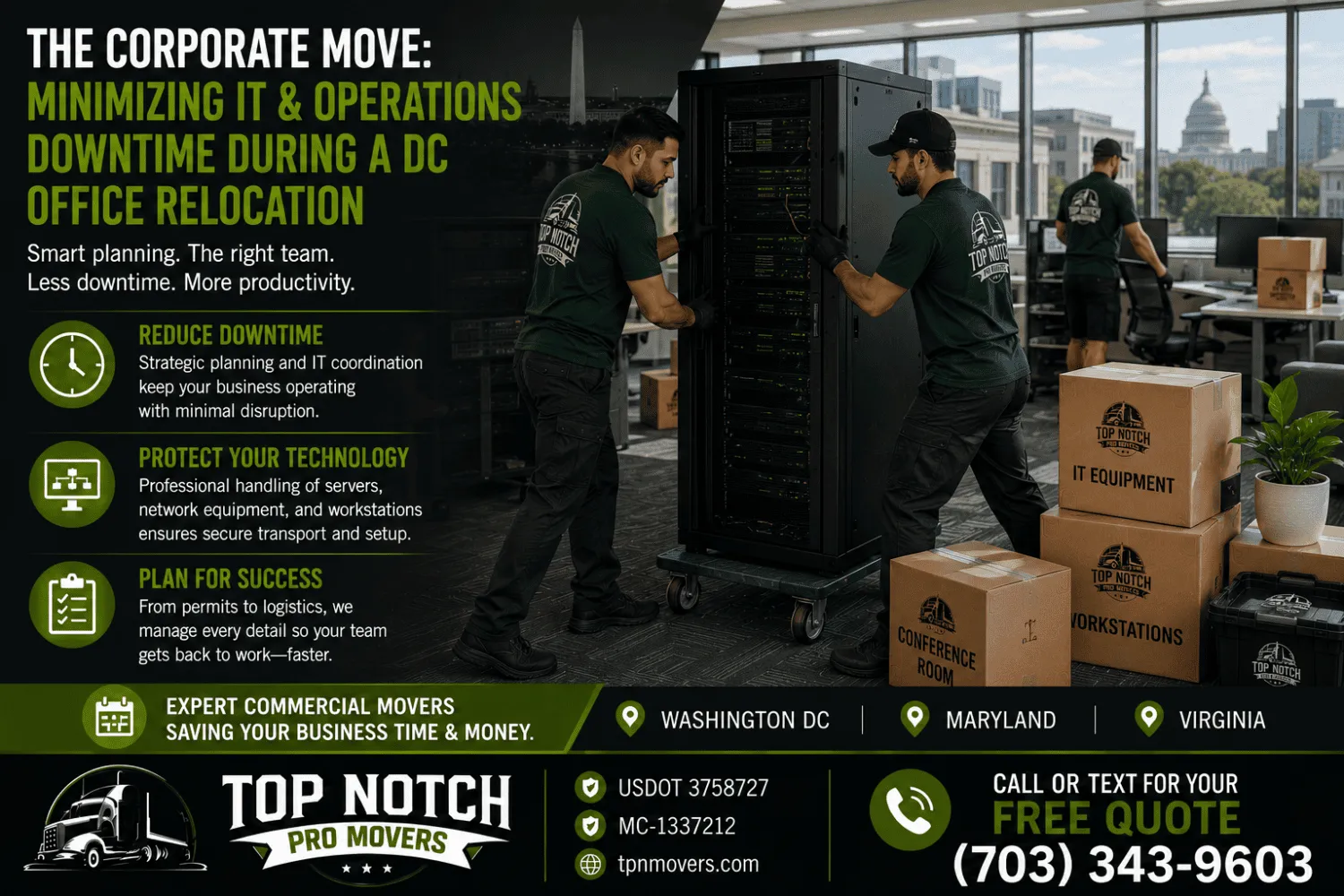


When a company shifts into a hybrid work model, the physical office rarely stays the same size or sits in the same location for long. Downsizing a headquarters, opening a satellite hub closer to where employees actually live, or folding two half-empty floors into one efficient space all come with a physical move attached to them. For a business based in Northern Virginia, that might mean working with a local moving company in Virginia for a short move across town, a commercial moving company in Virginia for a full office build out, or long distance moving in Virginia when a hybrid strategy pulls a division into a different state entirely. Coordinating a move like this takes more planning than a standard office relocation once did, and companies that treat it as a checkbox item tend to pay for it later in downtime, damaged equipment, or frustrated staff. TPN Movers has worked alongside a number of Virginia businesses through exactly this kind of transition, and the patterns that come up again and again are worth understanding before the first box gets packed.
The New Shape of Corporate Relocation
Office relocation in 2026 looks different than it did even three years ago. Growth opportunity has overtaken business climate as the leading reason companies cite for moving, and real estate considerations, particularly lower lease rates or space built for hybrid schedules, now factor into more than a quarter of headquarters decisions. A large share of that movement is happening within the same metro area rather than across state lines, as companies rethink how much square footage they actually need once a portion of the workforce is working from home two or three days a week.
Cost remains the single biggest driver. Well over half of U.S. office relocations point to rent, taxes, or operating expenses as the primary trigger, and roughly four in ten relocating companies are landing in a smaller footprint than the one they left. That downsizing trend is a direct byproduct of hybrid scheduling: fewer desks are occupied on any given day, so fewer desks get leased.
What Hybrid Work Actually Changes About Planning a Move
A hybrid transition rarely produces one clean move. It tends to produce a sequence of smaller, more surgical ones. A company might vacate 40,000 square feet and take 22,000 somewhere else, while also setting up a satellite office near a talent pool it couldn’t reach before. Some organizations are also leaning on what’s being called commuter relocation, where an employee takes on a shorter-term, high-impact assignment without a full household move, which still requires professional packing and transport of equipment or partial household goods on a tighter timeline.
That variability changes what a moving partner needs to be good at. A single vendor may need to handle a local office consolidation, a cross-country transfer for a relocating executive, and the logistics of a commercial build out, sometimes in the same quarter. Below is a rough comparison of how a traditional full office relocation differs from the moves that tend to come out of a hybrid transition.
Traditional Office Move vs. Hybrid-Model Relocation Traditional Office Move vs. Hybrid-Model Relocation
| Factor | Traditional Full Office Move | Hybrid-Model Relocation |
|---|---|---|
| Footprint change | Same size or larger | Often smaller, sometimes split across two sites |
| Timing | One planned weekend or week | Rolling, phased over weeks or months |
| Employee impact | Entire staff relocates together | Staff split between on-site, hybrid, and remote schedules |
| Vendor needs | Single large-scale move | Mix of local, commercial, and long-distance services |
| Decision driver | Growth or lease expiration | Cost control and space efficiency |
Cost and Talent Pressures Are Shaping Timelines
Budgets for relocation programs have generally held steady or grown even as scrutiny over spending has increased. At the same time, a meaningful share of employees are declining relocation offers outright, often to protect a low mortgage rate on a home they already own or to avoid uprooting family life for a job that may only require in-office presence a few days a week. That resistance means HR and operations teams are negotiating relocation terms more carefully than before, and it puts pressure on the logistics side to be flexible rather than rigid.
Mid-sized companies feel this most acutely. They tend to have less internal capacity than large enterprises to manage a phased relocation, but they’re also the group most likely to keep flexible work policies in place long term. That combination, limited internal resources and a hybrid structure that isn’t going away, is why more of these businesses are outsourcing relocation logistics rather than managing it in-house.
Matching the Move Type to the Situation
Not every relocation tied to a hybrid strategy looks the same, and the planning window differs quite a bit depending on scope.
Move Type Snapshot for a Growing Company
| Move Type | Typical Scenario | Recommended Planning Window |
|---|---|---|
| Local move | Consolidating offices within the same metro area | 4 to 6 weeks |
| Commercial move | Full office buildout, IT and furniture included | 8 to 12 weeks |
| Long distance move | Relocating a division, executive, or satellite team out of state | 10 to 16 weeks |
A local consolidation can move quickly because most logistics stay within one region. A long-distance transfer, on the other hand, needs lead time for carrier scheduling, interstate permitting, and coordinating arrival with lease or hiring timelines on the other end. Companies that shorten these windows tend to pay premium rates or lose access to preferred moving dates altogether.
Practical Steps for Planning the Move
A few habits separate the relocations that go smoothly from the ones that don’t. Start with a full inventory of IT equipment, furniture, and records before any date is set, since data on volume drives both the quote and the crew size. Loop in the moving partner early enough that they can flag building access restrictions, freight elevator reservations, or loading dock hours that could otherwise stall a move-in day. Communicate the plan to staff well before the move, particularly for employees whose hybrid schedule means they may not see the new space until their next in-office day. Finally, build in a buffer week between vacating the old space and full operation in the new one, since IT setup and furniture installation rarely finish exactly on schedule.
Firms like Top Notch Pro Movers that work regularly with Virginia businesses tend to see the same failure points repeat: incomplete inventories, last-minute date changes, and a lack of a single point of contact managing the move internally. None of those are logistics problems so much as planning problems, and they’re avoidable with a few extra weeks of lead time.
Closing Thoughts
Hybrid work hasn’t eliminated the need for office relocations. If anything, it has made them more frequent and more varied, ranging from small local consolidations to full interstate transfers tied to a talent strategy. Companies that plan around that variability, rather than assuming every move looks the same, tend to come out the other side with less disruption and a workspace that actually matches how their team works now. Top Notch Pro Movers has seen firsthand how much smoother these transitions go when the move is planned as part of the broader workplace strategy rather than bolted on at the end of it.
Frequently Asked Questions
Does a hybrid work policy actually reduce how often companies need to relocate?
Not necessarily. Hybrid scheduling changes the size and frequency of moves more than it eliminates them. Many companies end up moving into smaller, more efficient spaces or splitting operations across a main office and a satellite hub, which can mean more relocations rather than fewer, just on a smaller scale each time.
How much lead time should a company give itself for an office relocation tied to a hybrid transition?
It depends on scope. A local consolidation within the same metro area can often be planned in four to six weeks, while a full commercial buildout or an out-of-state transfer usually needs eight to sixteen weeks to account for permitting, carrier scheduling, and IT setup.
What’s the biggest mistake companies make when planning a hybrid-related move?
Treating the move as a single event rather than a phased process. Hybrid transitions often involve staggered timelines, partial moves, and employees who won’t see the new space right away, so a plan built for a traditional one-day move tends to fall apart under that complexity.
Do smaller offices still need a commercial moving company, or can they handle it internally?
Even a smaller footprint move typically involves IT infrastructure, sensitive equipment, and furniture that benefit from professional handling. Internal teams can manage communication and scheduling, but the physical logistics are usually better handled by a mover experienced with commercial build outs.
How does a long-distance relocation differ from a local one for a hybrid company?
A long-distance move involves interstate logistics, carrier availability, and coordination with a new lease or hiring timeline in another state, which requires significantly more lead time than a local move. It also tends to involve fewer employees at once, since hybrid strategies often relocate a single division or a small team rather than an entire company.