
Relocating a business is a different animal than moving a household, and Baltimore adds its own layer of complexity on top of that. Between downtown loading dock restrictions, older commercial buildings with narrow freight elevators, and the port city’s dense one-way street grid, a commercial move here requires far more upfront planning than most business owners initially budget for. The companies that get this right tend to start planning months, not weeks, before the actual move date.
That gap in planning time matters more than people expect. According to the Institute of Real Estate Management, businesses that don’t build a formal relocation timeline are significantly more likely to experience unplanned downtime, and every hour a business is offline during a move has a direct, measurable cost, whether that’s lost sales, missed client meetings, or idle payroll. A commercial move isn’t just a bigger version of a home move; it involves coordinating IT infrastructure, employee schedules, vendor notifications, and often a building’s specific move-in and move-out rules, all at once.
If your business has multiple locations or is comparing regional providers, you may have already come across trusted movers in Baltimore, since a number of companies in Baltimore that handle commercial accounts serve both the Baltimore and D.C. metro corridors. The core planning principles carry over between markets, but Baltimore’s downtown core, with its historic rowhouse-style office buildings and limited loading zones, has specific logistics worth understanding before you set a date.
Start With a Realistic Timeline
Most commercial moving consultants recommend beginning the planning process 10 to 12 weeks out for a mid-sized office, and longer for larger operations with specialized equipment or server rooms. The table below outlines a general framework, though the exact timeline shifts depending on square footage and the complexity of your IT setup.
| Timeframe | Key Tasks |
|---|---|
| 10-12 weeks out | Finalize new lease, get moving quotes, notify staff |
| 6-8 weeks out | Inventory equipment, plan IT/server migration, order supplies |
| 4 weeks out | Notify vendors, clients, and update business listings |
| 2 weeks out | Confirm building access, elevator reservations, parking permits |
| Moving week | Final walkthrough, label everything, execute the move plan |
Baltimore’s downtown buildings frequently require certificates of insurance and advance elevator booking, sometimes with a 48- to 72-hour notice window, so this is one detail that can quietly derail an otherwise well-planned schedule if it’s left until the last minute.
Budget for More Than the Truck
Business owners often price a commercial move based on the moving company’s hourly rate alone, without factoring in the other costs that come with relocating an office. It helps to separate the move into categories before requesting quotes.
| Cost Category | What It Typically Covers |
|---|---|
| Labor and transport | Crew, truck, mileage, fuel surcharges |
| IT and data migration | Server relocation, network setup, cabling |
| Furniture disassembly/reassembly | Cubicles, conference tables, modular systems |
| Building fees | Elevator reservations, insurance certificates, permits |
| Downtime costs | Lost productivity during the transition window |
Getting a detailed, itemized quote rather than a flat estimate makes it much easier to compare providers and spot gaps before the invoice arrives.
Plan the IT Migration Separately From the Physical Move
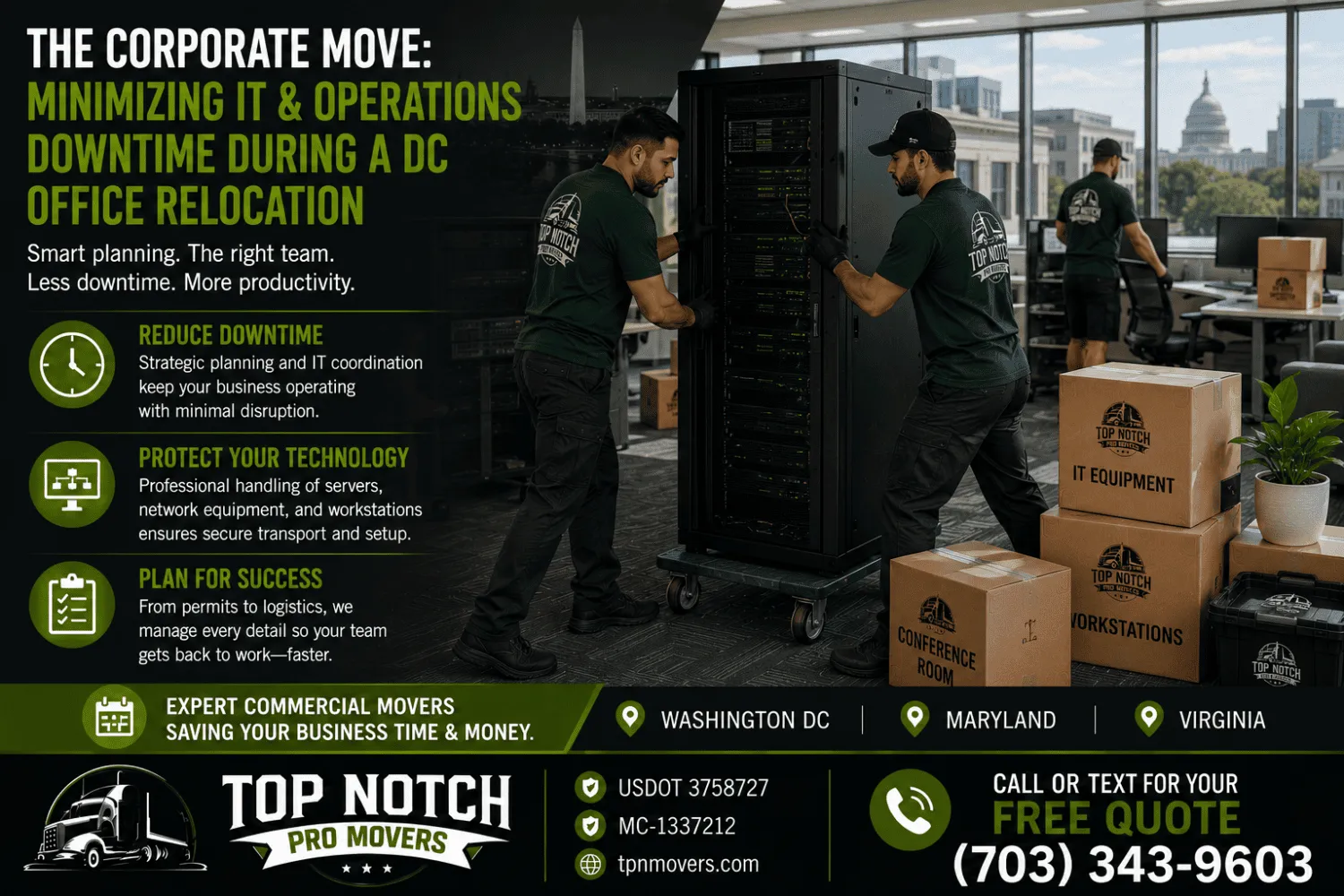
Server downtime is one of the most disruptive parts of a commercial relocation, and it’s also one of the most preventable. Many businesses schedule their IT migration for a weekend, running a parallel setup at the new location so systems can be tested before the old location goes offline completely. This adds a short-term cost but significantly reduces the risk of an extended outage during business hours.
Communicate the Move Internally and Externally
Employees need advance notice not just of the move date, but of any changes to commute times, parking arrangements, or building access procedures. Externally, updating your Google Business Profile, website, and any directory listings should happen close to the actual move date, not weeks in advance, to avoid confusing clients who might show up at the wrong address.
Companies like Top Notch Pro Movers that handle both residential and commercial accounts often have a clearer sense of how to sequence this kind of communication, since office relocations tend to involve more moving parts than a typical home move and benefit from a coordinated checklist rather than an ad hoc approach.
Account for Baltimore-Specific Logistics
Downtown Baltimore’s older commercial buildings, particularly around the Inner Harbor and Mount Vernon, often have narrower freight elevators and stricter loading dock schedules than newer suburban office parks. If your new or old space is in one of these buildings, confirm elevator dimensions and reservation windows well ahead of time, since a mismatch between truck equipment and building access is one of the more common causes of moving-day delays in this part of the city.
Parking is another factor that catches businesses off guard. Many downtown streets require temporary no-parking permits for moving trucks, similar to what’s required in some Northern Virginia and Maryland suburbs, and processing these can take several business days through the city’s transportation department.
Choose a Mover With Commercial Experience
Not every moving company that handles residential jobs is equipped for commercial relocations. Ask specifically about experience with office furniture systems, IT equipment handling, and after-hours or weekend scheduling, since many businesses prefer to move outside of standard operating hours to minimize disruption. A provider like Top Notch Pro Movers that offers both types of service can usually speak directly to how commercial jobs differ in staging, labeling, and equipment needs compared to a standard household move.
Final Walkthrough and Closeout
Before handing back the keys to your old space, do a full walkthrough to confirm nothing was left behind, check for any damage that needs to be documented, and take photos for your records. This step also matters for lease closeout requirements, since many commercial leases require the space to be returned to a specific condition. On the receiving end, verify that all equipment arrived and functions correctly before your team resumes full operations, and keep a copy of the mover’s inventory list in case anything needs to be flagged.
Businesses that treat a commercial move as a project with its own timeline, rather than an extension of the day-to-day workload, tend to come out the other side with far less disruption. Whether you’re relocating a small office or a full operational floor, working through the planning stages methodically and choosing a mover like Top Notch Pro Movers or another provider with real commercial experience makes the difference between a stressful week and a smooth transition.
Frequently Asked Questions
1. How far in advance should a business start planning a commercial move in Baltimore?
Most consultants recommend starting 10 to 12 weeks out for a mid-sized office, and even earlier for larger operations with server rooms or specialized equipment.
2. Do downtown Baltimore buildings require special permits for moving?
Many do. Certificates of insurance, elevator reservation windows, and temporary parking permits are common requirements, particularly in older buildings around downtown and the Inner Harbor.
3. How can a business minimize downtime during a move?
Scheduling the physical move and IT migration separately, often over a weekend with a parallel system setup, is one of the most effective ways to reduce the length of an outage.
4. What’s typically not included in a standard commercial moving quote?
IT and data migration, furniture disassembly and reassembly, and building-related fees like elevator bookings or insurance certificates are often billed separately from the base labor and transport cost.
5. Should employees be involved in packing for an office move?
It depends on the scale of the move. Smaller offices sometimes have staff pack personal items and desks, while larger relocations usually benefit from a professional crew handling the full process to keep the timeline on track.