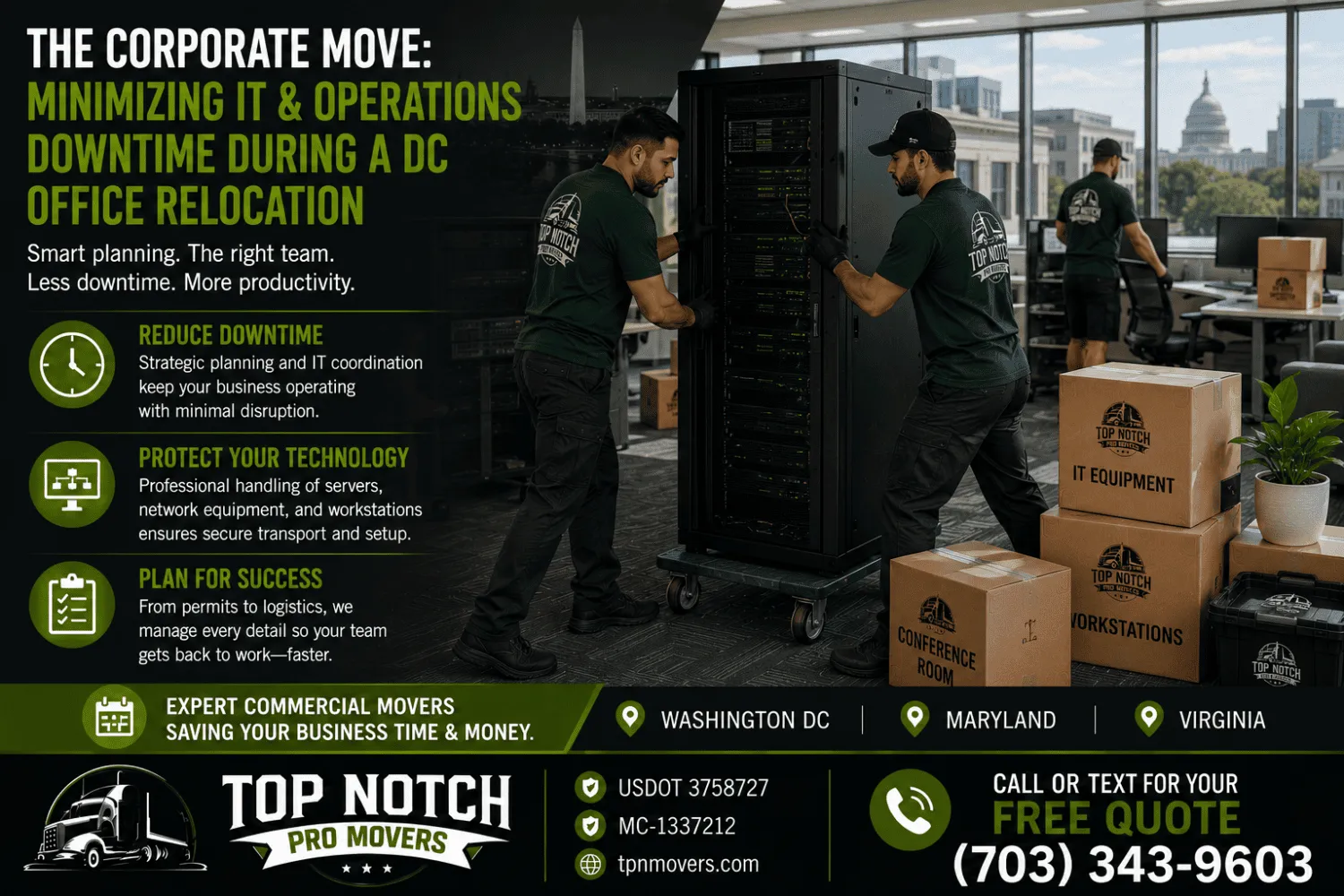

Retail relocation is not simply a matter of packing boxes and calling a truck. For a shop owner in Fairfax, Alexandria, or Stafford, a move touches inventory counts, lease timing, point-of-sale systems, and the handful of days when the doors have to stay closed. The margin for error is thin, since every closed day is a day without revenue. Working with a local moving company in Virginia that understands the region’s traffic patterns, loading dock restrictions, and permit requirements can make the difference between a two-day transition and a two-week headache.
Northern Virginia’s retail market has been shifting for several years, with rising commercial rents in Arlington and Tysons pushing smaller retailers toward Stafford, Fredericksburg, and other outer suburbs where square footage costs less and parking is easier for customers. According to the Bureau of Labor Statistics, retail trade establishments in Virginia numbered over 30,000 as of the most recent County Business Patterns data, and turnover in commercial leases has kept commercial movers busy year-round. Understanding the process before signing a new lease saves both money and stress.
Step 1: Audit Inventory and Fixtures Before You Get a Quote
The first practical step is a full inventory audit. Retailers often underestimate how much of their footprint is fixtures rather than product: shelving units, display cases, checkout counters, and signage all need to be measured, tagged, and assessed for whether they are worth moving or better replaced. A shop with heavy wood or glass displays should plan for specialized handling, since furniture moving in Virginia requires different equipment and packing materials than standard boxed inventory. Fragile displays, mirrors, and glass shelving are common casualties in DIY moves, and replacement costs often exceed what professional handling would have cost in the first place.
Step 2: Decide Between DIY and Professional Help
Many retail owners try to save money by handling the move themselves, using staff and a rented truck. This can work for a small kiosk or a single-room boutique, but it introduces real risk for anything larger. The table below breaks down the trade-offs.
| Factor | DIY Move | Professional Commercial Move |
|---|---|---|
| Time to complete | 3-7 days, dependent on staff availability | Typically 1-2 days |
| Risk of inventory damage | Higher, especially for fragile fixtures | Lower, with padding and proper equipment |
| Insurance coverage | Usually none unless separately purchased | Often included or available as an add-on |
| Staff productivity impact | Staff pulled from sales duties | Staff can continue normal operations |
| Cost predictability | Variable, hidden costs common | Fixed quote in most cases |
For most retail operations above roughly 1,500 square feet, hiring a dedicated commercial mover ends up being the more economical choice once lost sales hours and damage risk are factored in. A commercial moving company in Virginia will typically send a representative to walk the space, note loading dock access, elevator availability, and any items requiring disassembly, and provide a written quote based on that walkthrough rather than a phone estimate.
Step 3: Build a Realistic Timeline Around Your Lease
Lease overlap is one of the most overlooked parts of retail relocation. Ideally, a business should have at least one week of overlap between the old and new locations, even if that means paying rent on both spaces briefly. This overlap window allows fixtures to be installed and tested at the new site, signage to be permitted and hung, and point-of-sale internet service to be confirmed before the old location closes. Rushing this step is the single most common cause of extended closures during a retail move.
Step 4: Plan for Storage If Timelines Don’t Align
It is common for a new retail space to need buildout work, permits, or inspections that take longer than expected, leaving a gap between move-out and move-in dates. In that situation, secure short-term storage protects inventory and fixtures from weather and theft exposure that comes with leaving items in a truck or an unsecured space. Reliable storage solutions with climate control matter especially for retailers carrying leather goods, electronics, or anything sensitive to humidity swings, which are common in Virginia summers.
Step 5: Account for Heavy Lifting and Specialty Labor
Not every retail move needs a full truck and crew. Some businesses only need help getting heavy shelving units, safes, or industrial equipment from one point to another within the same building or a short distance away. In these cases, labor only moving services can be more cost-effective than a full-service move, since the business supplies the truck or the items are already at the destination and simply need positioning, assembly, or disassembly.
Step 6: Consider Distance and Multi-Location Logistics
Some Northern Virginia retailers are not just relocating across town, they are consolidating locations or moving a flagship store to a new region entirely. That kind of move carries different logistics than a local relocation, including DOT regulations, longer transit insurance requirements, and coordination across multiple delivery windows. Long distance moving in Virginia requires more advance notice, typically four to six weeks, compared to the one to two weeks often sufficient for a local move.
| Move Type | Typical Lead Time | Key Consideration |
|---|---|---|
| Local (same county/metro) | 1-2 weeks | Dock access, parking permits |
| Regional (across Virginia) | 2-4 weeks | Multi-stop scheduling, transit time |
| Long distance (interstate) | 4-6 weeks | DOT regulations, extended insurance |
Step 7: Don’t Forget the Owner’s Own Household
Retail relocations are rarely purely business affairs. Small business owners in this region frequently move their household at the same time as their store, particularly when relocating to a new city entirely. Coordinating both moves with the same provider can simplify scheduling, since residential movers in Virginia can often be scheduled back-to-back with a commercial crew, reducing the number of separate vendor relationships an owner has to manage during an already busy stretch.
What the Data Says About Retail Move Timing
Industry surveys consistently show that the majority of commercial relocations happen in the second and third quarters of the year, largely tied to lease renewal cycles that run on calendar-year terms. Retailers who move outside of peak season, in January or February, often report better crew availability and more flexible scheduling, since demand is lower industry-wide. Planning a move around this seasonal pattern, rather than around the pressure of a lease deadline, gives a retailer more negotiating room on both price and timeline.
Top Notch Pro Movers has worked with retail operators across Stafford and Fredericksburg who found that a January move let them negotiate a longer overlap period with their landlord than would have been possible in June. That kind of flexibility is worth building into a relocation plan from the start rather than discovering it after a lease is already signed.
A retail move touches nearly every part of a business at once: inventory, staff schedules, customer communication, and lease obligations. Breaking the process into the steps above, audit, decide on labor, build a realistic timeline, plan for storage gaps, and account for distance, turns an overwhelming project into a manageable checklist. Businesses that treat the move as a planned operation rather than a scramble tend to reopen faster and with less inventory loss, which in retail is often the difference between a strong quarter and a weak one. Top Notch Pro Movers has seen firsthand how much smoother a transition goes when these steps are followed in order rather than improvised under deadline pressure. For owners weighing their options, Top Notch Pro Movers remains a resource worth talking to before a lease deadline forces a rushed decision.
Frequently Asked Questions
How far in advance should a retail business start planning a relocation?
Most retailers should begin planning at least eight weeks before the target move date for a local relocation, and up to twelve weeks for a long-distance or multi-location move. This gives time to secure permits, schedule crews during busy seasons, and arrange lease overlap.
What is the biggest cost retailers underestimate in a move?
Lost sales during closure days is usually the largest hidden cost, followed closely by damage to fixtures and display cases that weren’t packed with commercial-grade materials.
Can a retail move happen without closing the store at all?
In some cases, yes, particularly for businesses with a back-of-house stockroom that can be relocated first while the sales floor stays open, followed by a single overnight changeover for the remaining fixtures.
Is it worth paying for storage during a retail relocation?
When there is any gap between the old lease ending and the new space being ready, storage is almost always worth the cost compared to the risk of damage, theft, or having inventory sit in a parked truck.
Do retail movers handle point-of-sale and IT equipment?
Most commercial movers can transport computers, registers, and networking equipment, though it is worth confirming in advance whether disconnection and reconnection of cabling is included or handled separately by an IT vendor.