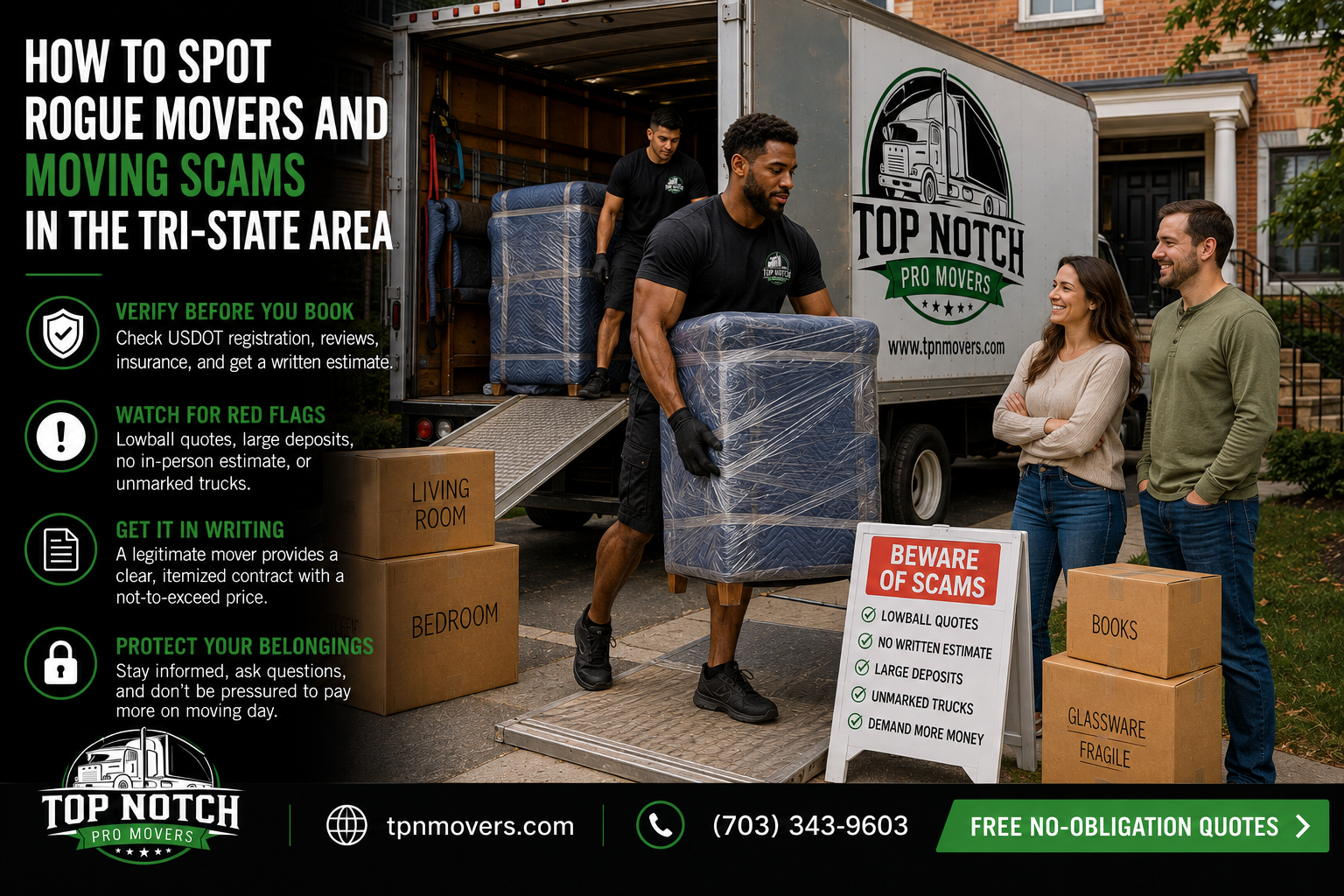

Moving fraud isn’t a rare occurrence. The Federal Motor Carrier Safety Administration receives thousands of moving fraud complaints every year, and the agency has launched Operation Protect Your Move specifically to crack down on rogue movers who hold household goods hostage or vanish after collecting a deposit. Households across the Tri-State area planning a move should know what these warning signs look like before signing anything, not after a truck full of belongings has already driven off. Established movers, including Top Notch Pro Movers, generally welcome the scrutiny, since a legitimate company has nothing to hide behind a USDOT number, a physical address, or a written estimate.
Even a short move across town carries risk if the company on the other end isn’t who it claims to be. Verifying a local moving company in Virginia before booking, checking for a physical business address, consistent branding, and a company that will send someone to look at your belongings in person rather than quote blind over the phone, is one of the simplest ways to filter out operators who aren’t running a legitimate business.
Rogue movers show up more often on longer routes, where the distance between pickup and delivery makes it harder for a household to follow up if something goes wrong. Anyone booking long distance moving in Virginia services should confirm the company’s active USDOT and MC numbers through the FMCSA’s public database before paying any deposit, since interstate movers are legally required to register with the agency and unlicensed operators have no such registration to check.
Businesses aren’t immune to this either. A company relocating an office or retail location can lose just as much to a fraudulent operator, sometimes more, given the value of commercial equipment and fixtures involved. Vetting a commercial moving company in Virginia the same way a household would, checking licensing, insurance, and references, protects a business from the same hostage-load tactics that target residential customers.
Most scam complaints still involve household moves rather than commercial ones, since residential customers are less likely to ask for documentation upfront. Comparing several residential movers in Virginia and requesting a written, not-to-exceed estimate from each one gives a homeowner something concrete to compare, and makes it obvious when one quote is priced well below the others for no clear reason.
One tactic rogue movers rely on is loading a truck, then refusing to unload it until the customer pays a much higher price than originally quoted. This is especially damaging with high-value or irreplaceable items, which is why some households choose to handle furniture moving in Virginia for their most valuable or sentimental pieces separately, using a small, insured local crew rather than trusting an entire household’s belongings to a single unverified operator.
Why Rogue Movers Are Still a Problem
Roughly 40 million Americans move each year, and that volume creates a large enough pool of rushed, stressed customers for fraudulent operators to target consistently. FMCSA data shows complaints have climbed well past the 5,900 filed in 2018, with overcharging and property damage or loss making up the majority of grievances. Losses tend to be significant when they happen: the average claim tied to a moving fraud complaint runs around $16,200, and fewer than a quarter of claims ever reach a settlement.
The Warning Signs Worth Knowing
Most rogue movers share a handful of behaviors, and spotting even one or two of them early is usually enough reason to keep looking. A company that won’t provide a USDOT number, refuses an in-home or video estimate, demands a large cash deposit, or shows up in an unmarked rental truck instead of a branded commercial vehicle is displaying the same pattern regulators and consumer advocates have flagged for years.
| Red Flag | What It Usually Means |
|---|---|
| No USDOT or MC number provided | Company may be operating illegally with no insurance |
| Phone-only estimate, no in-home visit | Estimate isn’t based on actual inventory weight |
| Large upfront cash deposit demanded | Common setup for a vanish-after-deposit scam |
| Unbranded truck or rental van | May not be a licensed commercial carrier |
| Contract has blank fields or vague terms | Leaves room to inflate charges after pickup |
| Only accepts Venmo, Zelle, or money orders | No paper trail, no way to dispute charges |
How to Verify a Mover Before You Book
Every interstate mover is required to register with the FMCSA and carry a valid USDOT number, and that registration can be checked for free at the agency’s public database before any money changes hands. Beyond the federal check, a quick look at how long the company has operated at its current address, whether its insurance certificate is current, and how it responds to a request for references tells most of what a household needs to know.
| Verification Step | What To Check |
|---|---|
| FMCSA registration | Active USDOT and MC number in good standing |
| Physical address | Real office or warehouse, not a P.O. box |
| Written estimate | In-home or video walkthrough, itemized inventory |
| Insurance certificate | Current, matches the company name on the contract |
| Payment method | Credit card or check, traceable and disputable |
Reading the Contract Before You Sign
A legitimate mover provides a copy of Your Rights and Responsibilities When You Move, a document required by federal law before an interstate move, along with a contract that spells out pickup and delivery dates, an itemized cost breakdown, and clear payment terms. Phrases like “estimate subject to change” buried in the fine print are worth asking about directly, since that language is often how a low initial quote turns into a much higher final bill.
What to Do if a Move Goes Wrong
Households that suspect they’ve been targeted by a rogue mover can file a complaint directly with the FMCSA through its online consumer complaint system, and should keep every document related to the move, the estimate, the contract, photos of belongings before pickup, and any correspondence, in one place. Reporting a bad actor doesn’t just help the household that was affected; it feeds into the same enforcement data that federal investigators use to identify and shut down repeat offenders.
Closing Thoughts
Most companies in the moving industry are legitimate and do the work they promise, but the minority that aren’t rely on customers being too rushed or too trusting to check basic credentials. A few minutes spent confirming a USDOT number, requesting an in-home estimate, and reading the contract closely is usually enough to filter out the operators worth avoiding. Movers with an established track record in the Tri-State area, a group that includes firms like Top Notch Pro Movers, are generally happy to provide licensing information and references upfront, since that transparency is exactly what separates a legitimate mover from a rogue one. Households that take the time to verify a company before booking, rather than after a problem shows up, are the ones least likely to become another line in the FMCSA’s complaint data, a pattern that companies like Top Notch Pro Movers see reflected in how often their own customers mention having compared several movers before deciding.
Frequently Asked Questions
How can I check if a moving company is legitimate?
Search the company’s name, USDOT number, or MC number in the FMCSA’s public moving company database. An active, valid registration confirms the company is licensed to operate as an interstate mover, and the database also shows any complaint history on file.
What’s a normal deposit amount for a moving company to request?
A deposit under 20 percent of the estimated total is typical. Requests for a much larger upfront payment, especially in cash or through a non-refundable app like Venmo or Zelle, are a common warning sign of a rogue mover.
What does it mean if my belongings are being held hostage?
This refers to a scam where a mover loads a truck, then refuses to deliver the belongings until the customer pays a much higher price than originally quoted. It’s one of the most common complaints reported to the FMCSA and is part of what Operation Protect Your Move specifically targets.
Should I be worried if a mover only gives a phone estimate?
Yes, that’s worth treating as a red flag. A legitimate mover typically performs an in-home or video walkthrough to build an accurate estimate based on actual inventory, rather than guessing over the phone and adjusting the price later.
What should I do if I think I’ve been scammed by a mover?
File a complaint with the FMCSA through its online consumer complaint system, dispute any charges made by credit card with your card issuer, and keep all documents related to the move, including the estimate, contract, and photos of your belongings, in one place in case further action is needed.