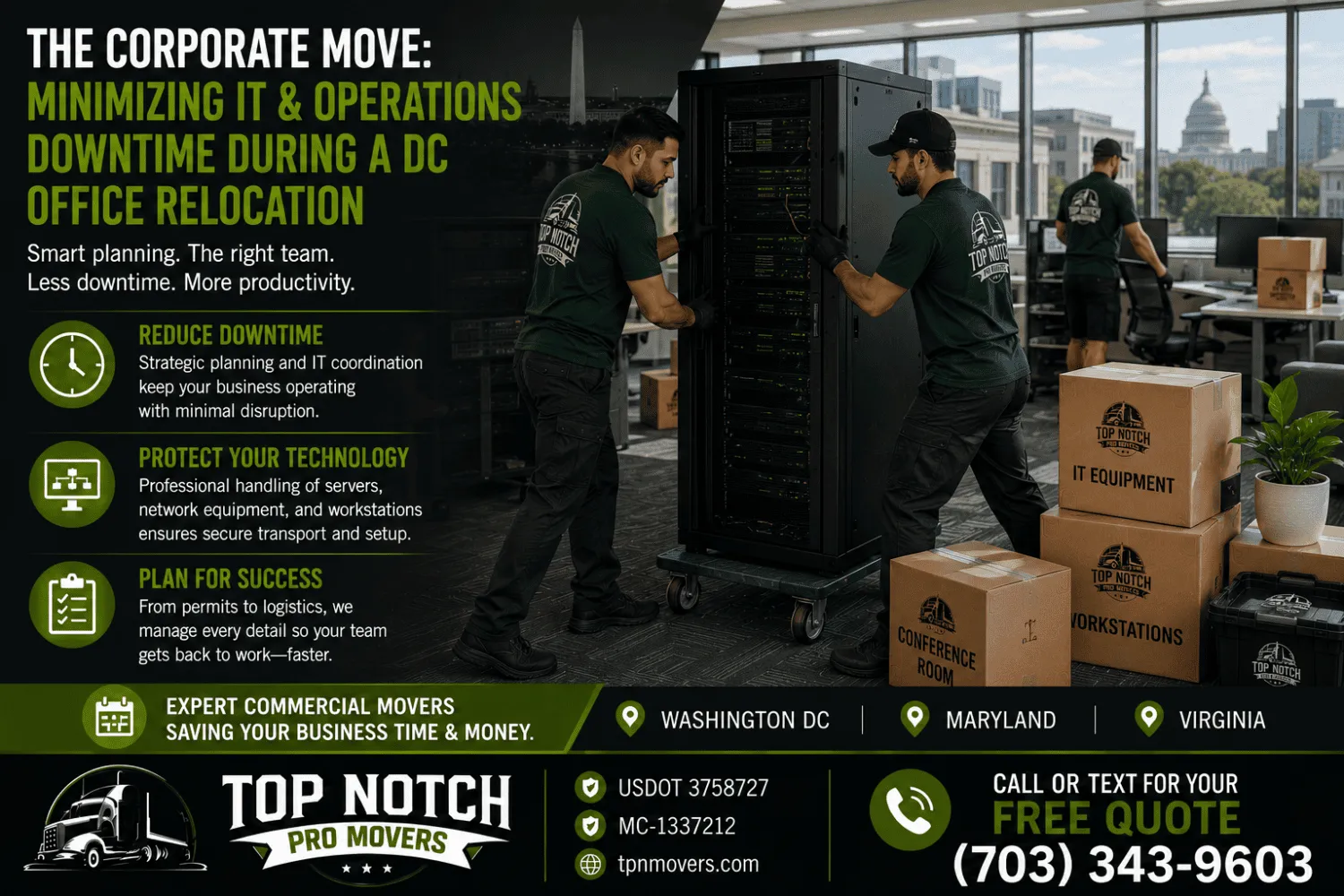

Northern Virginia’s retail corridors, from Tysons Corner to Old Town Alexandria to the Route 1 commercial strip near Fredericksburg, see constant turnover as national chains and independent shop owners reposition themselves in response to shifting foot traffic and rising lease costs. Retail relocation is rarely a spur-of-the-moment decision. It typically follows months of lease negotiations, site analysis, and quiet planning long before the first box is packed. Industry tracking shows that retail chains executed roughly 5,200 store moves in a single recent year, as brands adjusted their physical footprint to shifting consumer habits and the continued growth of e-commerce. Companies operating in this market, including Top Notch Pro Movers, see the pattern firsthand: storefronts change hands quickly, and owners who plan carefully tend to come out ahead of those who don’t.
For a Northern Virginia retailer, sequencing the move correctly is often the difference between a smooth transition and several weeks of lost revenue. Store owners who work with an established local moving company in Virginia tend to find that a documented plan, rather than improvisation, keeps a relocation on schedule and within budget.
Relocating a storefront is not the same undertaking as moving a law office or a software firm. Retail inventory carries resale value, display fixtures are frequently custom-built, and point-of-sale systems cannot stay offline for more than a few hours without cutting into sales. A commercial moving company in Virginia that regularly works with retail clients understands these constraints and sequences the move so that the inventory transfer occurs with minimal disruption to daily operations.
Retail also carries a public-facing dimension that other business types do not share. Customers need advance notice of an address change, exterior signage has to be updated, and heavy display fixtures require careful handling so they arrive at the new location undamaged. Coordinating furniture moving in Virginia as its own line item, separate from general inventory transport, reduces the risk of damage to shelving, counters, and custom cabinetry that are expensive and slow to replace.
Some Northern Virginia retailers are relocating within the same county or a few miles down the road, while others are consolidating multiple storefronts or entering a new regional market entirely. The permitting, cost structure, and scheduling for these two scenarios differ enough to warrant separate planning tracks. Owners expanding outside the immediate DMV area typically start researching long distance moving in Virginia earlier in the process, since interstate transport involves documentation and lead times that a same-day local move does not require.
Not every moving company is set up to handle a commercial storefront. Retailers sometimes assume that a crew experienced with residential movers in Virginia can simply be applied to a commercial job, but the equipment, insurance requirements, and scheduling flexibility often differ. A residential crew is generally built around single-day household moves, while a retail relocation frequently calls for overnight or off-hours work and coordination with contractors on the receiving end.
Step 1: Build a Realistic Timeline
Most successful retail relocations begin three to six months before the physical move takes place. That window gives an owner time to negotiate lease terms on both ends of the transaction, secure permits and inspections for the new space, and notify vendors and suppliers of the updated address. Retailers who wait until a lease is expiring to start planning often end up paying overlapping rent, or scrambling for short-term storage while permits catch up.
Step 2: Take Inventory Before You Touch a Box
Before packing begins, a full inventory count establishes what is moving to the new location, what is being liquidated, and what needs to be replaced entirely. This step also flags fragile or high-value fixtures that require specialized handling, along with any equipment tied to specific vendor service contracts that need updating before the move date.
Step 3: Decide Between Local and Long-Distance Logistics
Local relocations and longer regional moves are planned very differently. A local move can often happen over a weekend with a single crew, while a move into a new market may require coordinating a receiving team, temporary storage, and staggered delivery. The table below outlines how the two scenarios typically compare.
| Factor | Local Move (Within NoVA) | Long-Distance / Regional Move |
|---|---|---|
| Typical Lead Time | 6 to 10 weeks | 3 to 6 months |
| Permitting Complexity | Single jurisdiction | Multiple jurisdictions, new licenses |
| Inventory Transit Time | Same day | 1 to 5 days depending on distance |
| Storage Needs | Rarely required | Often required between lease dates |
| Vendor Notice Period | 2 to 4 weeks | 6 to 8 weeks |
Step 4: Coordinate Vendors, Utilities, and Staff Scheduling
A retail move touches more parties than the store itself. Utility transfers, point-of-sale and internet installation, alarm and camera systems, and supplier delivery schedules all need to be realigned to the new address before opening day. Staff scheduling matters as well. Most retailers stagger employee shifts around the move so the sales floor stays covered at the old location right up until the new one is ready, rather than closing entirely for an extended stretch.
Step 5: Weighing a DIY Move Against a Professional Crew
Owners deciding whether to handle the move internally with staff and rented trucks, or bring in a professional crew, are really weighing time against risk. A do-it-yourself move can look cheaper on paper, but hidden costs such as damaged fixtures, injured staff, or lost sales days often outweigh the upfront savings. Small business relocations generally run between $2,000 and $5,000, while mid-sized moves with more staff and equipment often fall between $5,000 and $15,000, depending on distance and the volume of fixtures involved.
| Consideration | DIY Move | Professional Moving Crew |
|---|---|---|
| Upfront Cost | Lower, truck rental only | Moderate, based on scope |
| Risk of Fixture Damage | Higher | Lower, trained handling |
| Staff Time Required | High, pulls staff off sales | Minimal |
| Insurance Coverage | Often limited or none | Typically included |
| Speed of Completion | Slower | Faster, dedicated crew |
Step 6: Moving Day Execution
On the day itself, a labeled, department-by-department plan keeps a crew moving efficiently and reduces the odds of items ending up in the wrong part of the new store. Assigning one point of contact on the retailer’s side to answer questions in real time, rather than leaving decisions to whoever happens to be on the floor, cuts down on delays significantly. Movers familiar with Northern Virginia’s commercial corridors, a description that fits firms like Top Notch Pro Movers, generally recommend a pre-move walkthrough of the new space to confirm loading zones, freight elevator access, and any building-specific move-in restrictions before the crew arrives.
Step 7: Settling In and Reopening
Once fixtures are placed and inventory is unpacked, a walkthrough against the original inventory count confirms nothing was lost or damaged in transit. Many Northern Virginia retailers treat the reopening as a small local event, inviting nearby businesses and regular customers to see the new space before it opens for regular hours. That soft launch also gives staff a chance to work out any kinks in the new layout before the full customer volume returns.
Closing Thoughts
A retail relocation in Northern Virginia is manageable when it is treated as a project with a timeline rather than a weekend scramble. Owners who build in enough lead time, separate inventory planning from fixture handling, and bring in a crew suited to commercial work tend to reopen faster and with fewer surprises. Companies such as Top Notch Pro Movers work within this market regularly, and the pattern holds across nearly every relocation: the storefronts that plan furthest are the ones that reopen with the least disruption to their customers.
Frequently Asked Questions
How far in advance should a Northern Virginia retailer start planning a relocation?
Most retail moves benefit from three to six months of lead time. That gives an owner room to negotiate lease overlap, secure permits for the new location, and notify vendors and suppliers before the move date, rather than scrambling in the final weeks.
Does a retail store need to close completely during the move?
Not necessarily. Many retailers stagger the process, keeping the original location open with reduced hours while fixtures and non-essential inventory move ahead of schedule, then closing only briefly for the final transfer.
What does a typical small business relocation cost in Virginia?
Small business moves generally run between $2,000 and $5,000, while mid-sized relocations with more staff, fixtures, and square footage often fall between $5,000 and $15,000, depending on distance and complexity.
Who is responsible for utility and internet transfers during a retail move?
That responsibility typically stays with the business owner or their operations manager, though many retailers start these transfers four to six weeks ahead of the move so services are active before staff or customers arrive at the new address.
What should a retailer look for when choosing a commercial mover?
Look for a crew with documented experience in retail or commercial moves, proper insurance coverage, and a willingness to do a pre-move site walkthrough. Firms that regularly serve Northern Virginia’s retail corridor, including Top Notch Pro Movers, are generally familiar with building access rules, loading zone restrictions, and the timing constraints unique to storefront relocations.