
Moving into a homeowners association community in Northern Virginia involves more than packing boxes and booking a truck. Homeowners associations across Fairfax, Loudoun, Prince William, and Arlington counties maintain their own move-in procedures, and skipping them can mean a rescheduled elevator reservation, a towed truck, or a fine added to next month’s dues. For anyone planning a move in the region, working with a local moving company in Virginia that already understands these community-specific rules can prevent a lot of the friction that catches new residents off guard.
Virginia has become one of the more HOA-dense states in the country. Statewide, more than 811,000 housing units fall under a homeowners association, and nationally 65% of newly built single-family homes are now part of a governed community, up from 49% in 2009. In Northern Virginia specifically, close to 80% of homes in new subdivisions carry HOA membership. That growth means more residents are running into moving-day rules for the first time, often without realizing those rules exist until move day itself.
Why HOAs Regulate Moving Day
An HOA’s governing documents typically include Covenants, Conditions, and Restrictions (CC&Rs) alongside a separate set of rules and regulations that boards update more frequently. Moving trucks usually fall under the second category. Boards restrict move-in and move-out logistics for a handful of practical reasons: protecting shared driveways and landscaping from heavy vehicles, keeping fire lanes clear in townhouse and condo clusters, managing elevator and loading dock schedules in mid-rise buildings, and containing noise and traffic to reasonable hours.
None of this is unique to Virginia, but the state’s mix of dense townhouse developments, high-rise condos in Arlington and Alexandria, and sprawling single-family subdivisions in Loudoun and Prince William means the specifics vary widely from one community to the next.
Common Restrictions Homeowners Run Into
Most HOA moving policies affecting residential movers in Virginia fall into a handful of recurring categories:
- Move-in time windows, often limited to weekday daytime hours
- Advance notice requirements, typically 24 to 72 hours before the move
- Truck size limits on narrow streets or in townhouse alleys
- Required certificates of insurance from the moving company
- Reserved elevator or loading dock time in condo and apartment-style buildings
- Restrictions on where boxes and packing materials can be staged outside the unit
HOA Restriction Categories at a Glance
| Restriction Type | Typical Requirement | Why It Matters |
|---|---|---|
| Move-in hours | Weekdays, 9 a.m.–5 p.m. in many communities | Limits noise and traffic during peak hours |
| Advance notice | 24–72 hours before move day | Lets management reserve elevators or loading zones |
| Insurance certificate | Liability coverage naming the HOA as additional insured | Protects common-area property from damage claims |
| Truck size | Restricted on narrow or private streets | Prevents damage to curbs, driveways, and landscaping |
| Deposit | Refundable fee in many condo buildings | Covers potential damage found during post-move inspection |
Truck Access, Parking, and Loading Rules
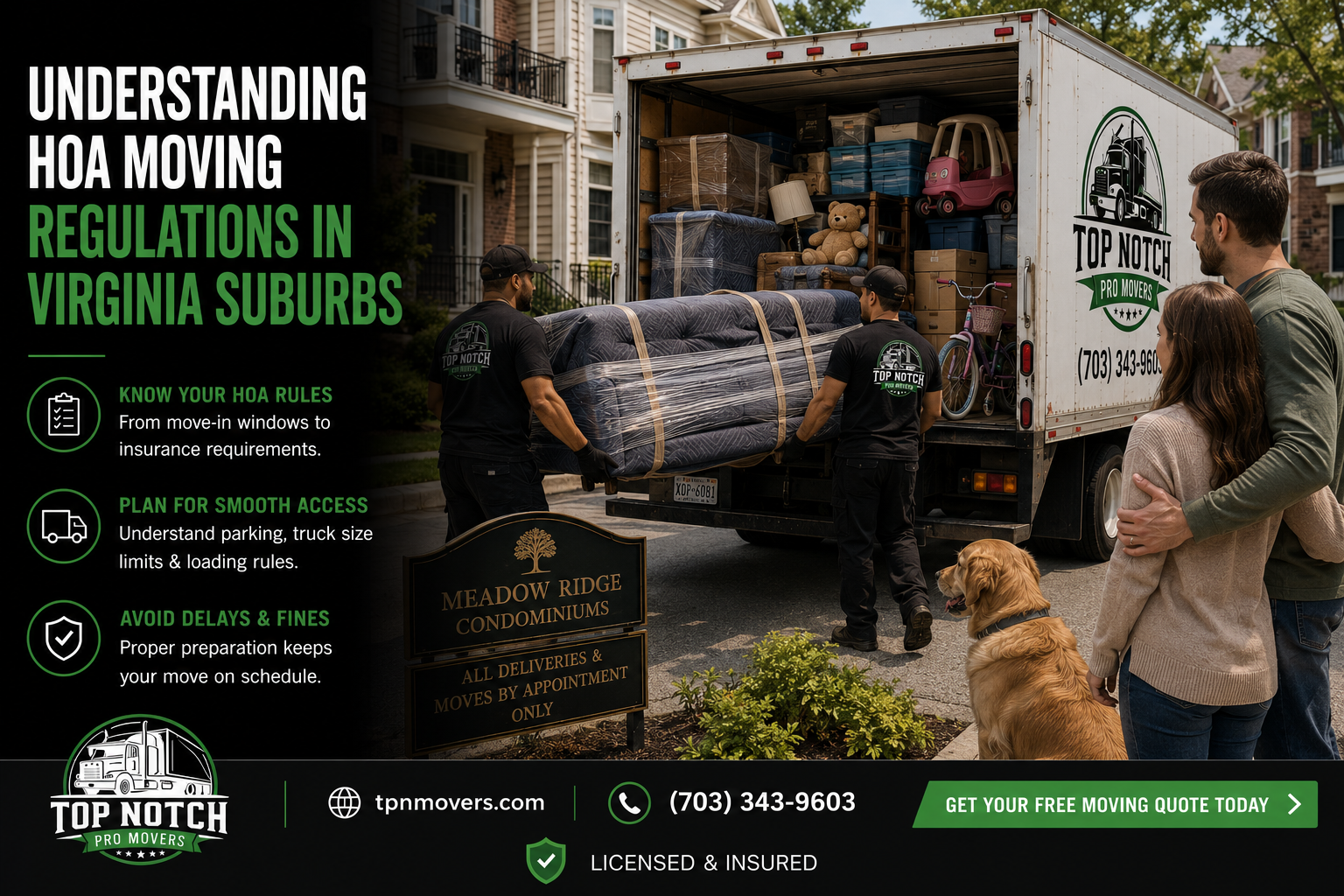
Truck size is one of the first things a homeowner should confirm with their HOA or property manager. Narrow streets in older townhouse communities and shared alley access common throughout Fairfax and Arlington can make a full-size moving truck impractical, regardless of what the mover would normally bring. Some associations cap vehicle length outright; others simply restrict parking to designated loading zones for a set window of time.
Scale matters here too. A single-family home move typically has more flexibility than an office relocation into a business park with its own property management rules. A commercial moving company in Virginia handling an office or retail relocation often needs to coordinate loading dock reservations, freight elevator time, and after-hours access separately from what a residential HOA requires, since commercial parks frequently layer their own property rules on top of local parking ordinances.
Beyond city and county permitting — several Virginia localities require a permit for oversized vehicles exceeding 20,000 pounds on a single axle — HOA rules operate as a separate layer. A state permit from the Virginia Department of Transportation does not exempt a mover from an HOA’s own truck-size or parking restrictions.
Advance Notice and Documentation
Most Virginia HOAs expect written notice before a move, submitted through the property management company rather than the board directly. Typical requirements include the move date and time window, the moving company’s name and DOT number, and a certificate of liability insurance naming the association or property manager as an additional insured. Condo and high-rise buildings frequently add a refundable move-in deposit to cover potential damage to common areas, released after a post-move inspection.
Households relocating from farther away face an added wrinkle: interstate carriers must comply with FMCSA licensing and documentation requirements on top of whatever the HOA asks for. Anyone coordinating long distance moving in Virginia into an HOA-governed neighborhood should confirm insurance paperwork with both the carrier and the HOA well before the delivery date, since certificates issued for interstate compliance don’t always match what a local association requires.
HOA Moving Rules by Community Type
| Community Type | Typical Access Rule | Common Extra Step |
|---|---|---|
| Single-family subdivision | Driveway and street parking generally allowed | Notify HOA if truck exceeds a set length |
| Townhouse community | Limited to designated visitor spaces or alleys | Reserve a loading zone in advance |
| Mid-rise or high-rise condo | Freight elevator reservation required | Certificate of insurance and refundable deposit |
Staging and Storage Around Restricted Access
When move-in windows are tight, or elevator access is limited to a single reserved block, staggering the move helps. Homeowners increasingly split large or bulky items into a separate load that arrives outside the restricted window. Reliable storage solutions give households a place to hold items until move-in day actually arrives, which matters when an HOA only grants a two-hour loading dock reservation for a four-bedroom home’s worth of belongings.
Furniture and Bulky Item Moves
The same logic applies to furniture moving in Virginia jobs specifically, since large pieces often require disassembly, protective wrapping, and sometimes a second trip through a narrow stairwell or freight elevator — all of which take longer than a typical HOA loading window allows for. Building this extra time into the move-day schedule, rather than assuming a single elevator trip will cover everything, is one of the more common gaps in first-time HOA moves.
Working With Movers Who Understand Local Rules
Homeowners who don’t need a full-service move but still want compliant, insured help on move day increasingly turn to labor only moving for tasks like loading a rented truck or carrying furniture through a building’s designated access route without violating elevator or hallway restrictions.
Top Notch Pro Movers has coordinated relocations across Northern Virginia’s HOA-governed communities long enough to know that the paperwork is rarely the hard part — it’s timing. A crew that shows up without a certificate of insurance, or outside the reserved window, can lose the elevator reservation entirely and get pushed to the next available slot, sometimes days later.
Common Mistakes That Delay Move Day
The most frequent issue isn’t a lack of planning; it’s assuming HOA rules mirror what the last community required. A resident moving from a single-family subdivision into a mid-rise condo often expects the same flexibility on truck parking and quickly finds a strict loading dock schedule instead. Confirming requirements directly with the property manager, rather than relying on an outdated homeowner handbook, remains the most reliable way to avoid a rescheduled move.
Top Notch Pro Movers builds move-day timelines around whatever documentation and access windows a specific HOA requires, which is part of why residential clients moving into Fairfax, Loudoun, and Prince William communities plan ahead rather than discovering the rules on move-in morning.
Frequently Asked Questions
Do all HOA communities in Virginia require advance notice for a move?
Not every association does, but most Northern Virginia HOAs, and nearly all condo and townhouse buildings, ask for written notice ranging from 24 hours to a full week before move day. Single-family subdivisions with wider streets sometimes have lighter requirements, but confirming with the property manager avoids surprises.
What happens if a moving truck violates HOA parking rules?
Consequences vary by community. Some HOAs issue a warning and require the truck to relocate; others can have it towed at the owner’s expense or apply a fine to the homeowner’s account. Repeated violations are typically noted in the association’s records and can affect future move approvals.
Does an HOA certificate of insurance differ from what a moving company already carries?
Often, yes. Most licensed movers carry general liability coverage, but an HOA usually wants a certificate naming the association or management company as an additional insured for the move date specifically. This is a quick request for an established mover but can take longer if arranged last minute.
Are HOA moving rules different for renters than for homeowners?
The rules themselves are usually the same, since they apply to the unit rather than the resident’s ownership status. Renters should still confirm move-in procedures with the property manager or landlord, since lease terms sometimes add separate requirements on top of the HOA’s own policy.
How far in advance should a Virginia HOA move be scheduled?
Two to three weeks is a reasonable window for most communities, allowing time to submit paperwork, secure an elevator or loading dock reservation, and confirm insurance documentation. Condo buildings with limited reservation slots or peak moving seasons in late spring and summer often fill up faster and benefit from earlier scheduling.
Conclusion
HOA moving regulations in Virginia suburbs exist to protect shared property and keep move days orderly across dense communities, but they add real logistical steps that homeowners need to plan for well in advance. Confirming truck access, notice periods, insurance requirements, and elevator or loading dock reservations directly with the property manager, rather than assuming one community’s rules apply everywhere, remains the clearest way to avoid delays. For households or businesses navigating this process, working with an experienced team such as Top Notch Pro Movers means someone is already tracking these requirements before move day arrives.