
Households in the DC metro area sit in an unusual position: a single move can begin in one jurisdiction and end in another within a matter of miles, yet the rules that apply can shift entirely depending on whether that move crosses a state or district line. A resident using a local moving company in Virginia for a short move stays under Virginia’s intrastate rules, while a commercial moving company in Virginia relocating an office to Maryland or DC moves into federal jurisdiction the moment the truck crosses the line. The same is true for long distance moving in Virginia that continues into another state. Readers who want a broader look at how movers are chosen and evaluated in this region can also review the resources published by Top Notch Pro Movers. This guide breaks down which rules apply where, and what DC, Virginia, and Maryland residents should verify before signing a contract with any mover.
Why Interstate Moves Fall Under Federal Law
Any household goods shipment that crosses a state or district boundary, even by a few miles, is legally classified as interstate commerce and falls under the jurisdiction of the Federal Motor Carrier Safety Administration, a division of the U.S. Department of Transportation. This distinction matters because federal law, rather than state law, governs the estimate process, the paperwork, the liability limits, and the complaint process for that shipment. A move that starts and ends within the same state, by contrast, is governed by that state’s own rules, which can differ significantly from federal requirements and from one neighboring jurisdiction to the next.
Federal Protections Every DC, Virginia, and Maryland Resident Should Know
Any company performing an interstate move must hold an active USDOT number and operating authority, both of which can be verified in a few minutes through the FMCSA’s public SAFER system before a contract is signed. Carriers are required to maintain minimum liability insurance, generally at least $750,000, along with cargo coverage for goods in transit. Before loading begins, movers must provide a written estimate that is clearly labeled as either binding or non-binding, followed by a Bill of Lading that serves as the receipt and contract for the shipment. Federal rules also limit how much a final bill can exceed a non-binding estimate, a protection commonly referred to as the 110 percent rule, and they prohibit so-called hostage load tactics in which a carrier withholds delivery of belongings to force additional payment. The FMCSA also publishes a consumer handbook, often titled Your Rights and Responsibilities When You Move, that outlines these protections in full.
How State Rules Differ Once a Move Stays Local
Once a shipment stays entirely within one jurisdiction, oversight shifts away from the FMCSA and toward that jurisdiction’s own regulator, and the three parts of the DC metro area do not handle this the same way. Virginia regulates intrastate household goods carriers through its Department of Motor Vehicles, with the licensing category depending on distance: moves of 30 miles or less generally fall under property carrier authority, while longer in-state moves require household goods carrier authority and adherence to a filed tariff. Maryland is in the middle of a transition, having shifted registration of household goods movers from the Public Service Commission to the Department of Labor under a household goods movers registration program, with proof of insurance and a registration number required before a company can legally book Maryland-only jobs. The District of Columbia takes yet another approach, requiring a Moving and Storage basic business license through the Department of Licensing and Consumer Protection, along with separate public space permits for trucks loading or parking on District streets.
Interstate vs. Intrastate: How the Rules Compare
| Factor | Interstate Move | Intrastate Move |
|---|---|---|
| Regulator | FMCSA (federal) | State or District agency |
| Required credential | USDOT number and MC authority | State license or registration |
| Estimate rules | Binding or non-binding, federally defined | Varies by state |
| Liability limits | Set by federal regulation | Set by state rule or contract |
| Complaint process | FMCSA consumer complaint database | State consumer protection office |
DC vs. Virginia vs. Maryland: Intrastate Oversight at a Glance
| Jurisdiction | Regulating Agency | Key Requirement |
|---|---|---|
| Washington, DC | Department of Licensing and Consumer Protection | Moving and Storage business license plus DDOT public space permit |
| Virginia | Department of Motor Vehicles, Motor Carrier Services | Certificate of fitness and filed tariff for moves over 30 miles |
| Maryland | Department of Labor (formerly Public Service Commission) | Household goods mover registration and proof of insurance |
Common Compliance Red Flags to Watch For
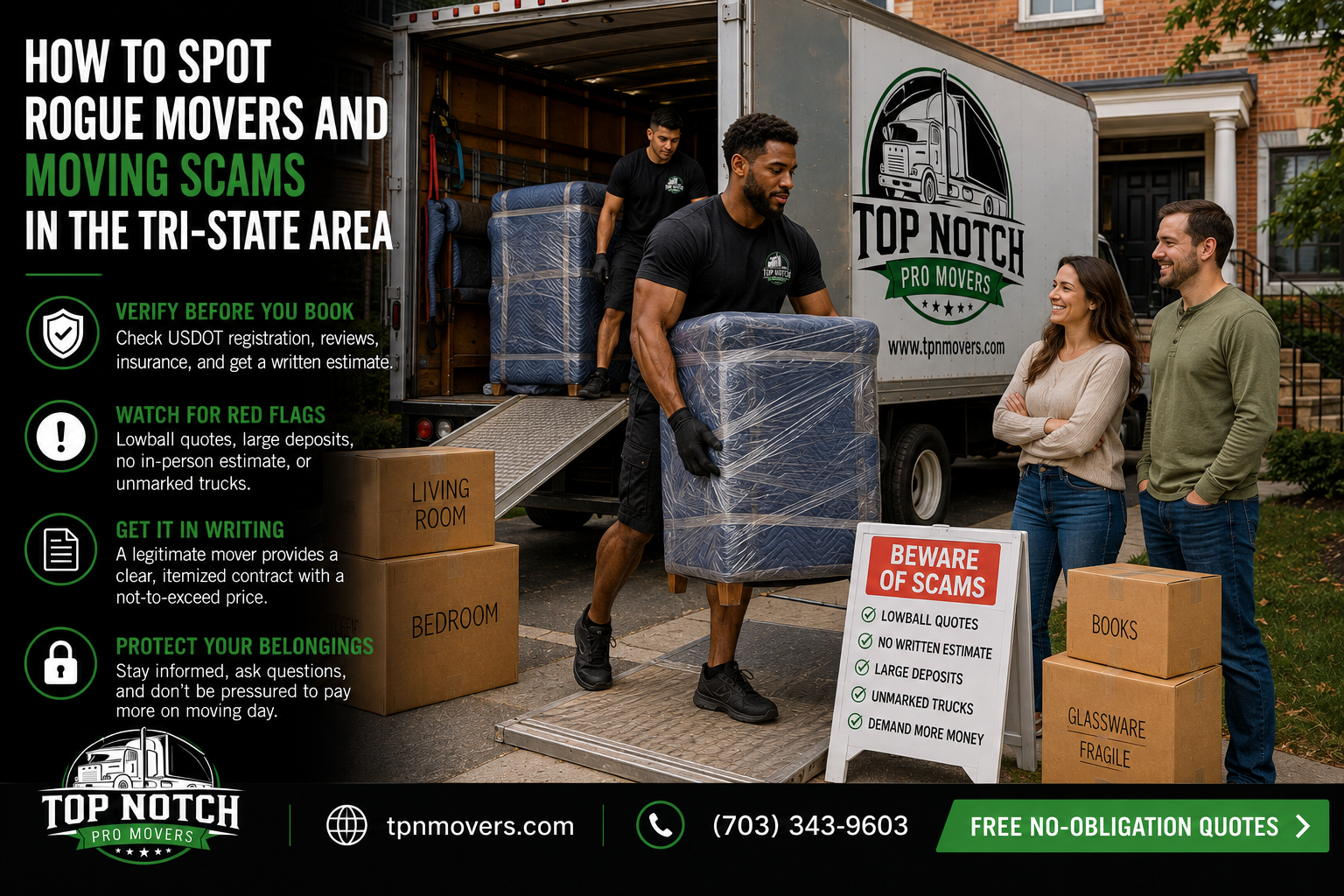
A mover that cannot provide a USDOT number for an interstate job, or a state registration number for a local one, is operating outside the rules that protect the shipment. Verbal estimates with no written follow-up, refusal to specify whether pricing is binding or non-binding, and demands for large cash deposits before any goods are loaded are all signs worth treating with caution. So is any attempt to withhold delivery of belongings until an inflated final balance is paid, a practice that federal regulation specifically prohibits on interstate shipments. Consumers who encounter this kind of behavior can document it and file a complaint with the FMCSA for interstate moves or with the relevant state agency for an intrastate one.
What Residents Should Confirm Before Signing
Before booking any mover for a DC, Virginia, or Maryland relocation, it is worth confirming which category the move falls into, since that single detail determines which rulebook applies. For interstate jobs, the USDOT number should be checked directly against the FMCSA’s SAFER database rather than taken at face value from a company’s own website. For moves that stay within Virginia, Maryland, or DC, residents should ask the company to confirm its current state registration or license number and provide it in writing. Firms that regularly serve this tri-jurisdiction market, including Top Notch Pro Movers, generally structure their paperwork so that the applicable authority, whether federal or state, is clearly documented before the move begins. Reviewing this paperwork in advance, rather than at delivery, remains the most reliable way to avoid a dispute later. Consultants who track compliance issues across the region, including those at Top Notch Pro Movers, note that most consumer complaints trace back to a missed step in this verification process rather than an outright scam.
Frequently Asked Questions
How do I know if my move is interstate or intrastate?
A move is interstate if the origin and destination are in different states or if it crosses the District of Columbia’s border into Maryland or Virginia. A move that starts and ends within the same state or entirely within DC is intrastate and follows that jurisdiction’s own rules.
What is the difference between a binding and non-binding estimate?
A binding estimate sets a fixed price for the services described in the contract, while a non-binding estimate is an approximation that can change based on the actual weight or services provided, subject to federal limits on how much the final bill can exceed the original estimate.
Does Maryland require a special license for movers?
Maryland is transitioning from Public Service Commission oversight to a Department of Labor registration program for household goods movers, which requires registration and proof of insurance before a company can legally perform in-state moves.
Can a mover withhold my belongings if I dispute the final price?
No. Federal regulations prohibit hostage load tactics on interstate shipments, meaning a carrier cannot refuse to deliver goods solely to pressure payment of a disputed or inflated balance.
Where can I file a complaint against a moving company?
Interstate move complaints can be filed through the FMCSA’s National Consumer Complaint Database, while intrastate complaints in DC, Virginia, or Maryland should go to that jurisdiction’s licensing agency or consumer protection office.
Final Thoughts
The DC metro area is one of the few regions in the country where a move of just a few miles can shift entirely from state to federal oversight, and each jurisdiction involved handles intrastate regulation differently. Understanding whether a move is governed by the FMCSA or by DC, Virginia, or Maryland’s own licensing rules, and verifying the corresponding credentials before signing anything, remains the clearest way for residents to protect their belongings, their budget, and their timeline.