
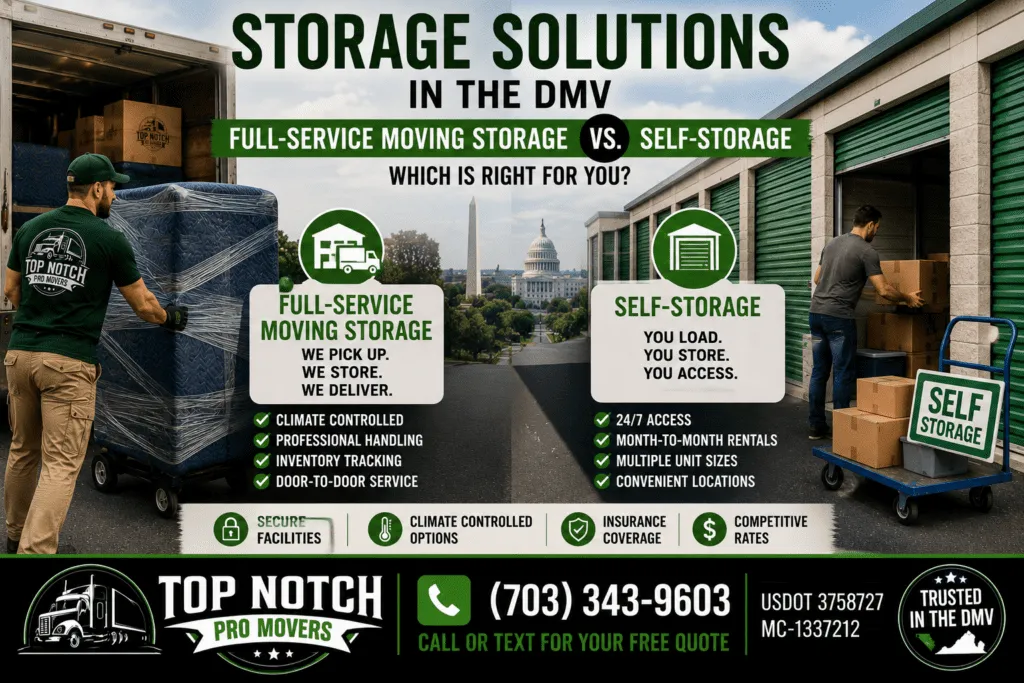
Whether you are working with a local moving company in Virginia, coordinating a transition through a commercial moving company in Virginia, or planning long distance moving in Virginia, one question comes up more often than most people expect: what do I do with my belongings in the gap between move-out and move-in? Storage is not always an afterthought. For many households and businesses across the DMV area — covering Washington D.C., Maryland, and Virginia — it is a critical part of the moving plan. Top Notch Pro Movers understands this reality, which is why this guide breaks down the two most common storage options so you can make the right call for your situation.
The DMV Moving Landscape: Why Storage Matters
The Washington D.C. metro area is one of the most transient regions in the United States. According to the U.S. Census Bureau, the DMV consistently ranks among the top metro areas for inbound and outbound moves, driven by federal employment cycles, military relocations, and the region’s dense corporate sector. With that volume of movement comes a practical challenge: closing dates, lease end dates, and job start dates rarely line up perfectly.
Industry data from the American Moving and Storage Association (AMSA) indicates that approximately one in three moves involves some form of temporary storage. In high-demand urban markets like Northern Virginia, D.C., and suburban Maryland, that number is likely higher. Understanding your storage options before you sign a contract with a moving company can save you both money and headaches.
What Is Full-Service Moving Storage?
Full-service moving storage, often called storage-in-transit or SIT, is a solution offered directly through your moving company. Rather than transferring your belongings to a separate facility, the moving crew loads your items into a climate-controlled moving van or a dedicated storage vault and holds everything until you are ready for delivery.
This model gained significant traction during the COVID-19 pandemic when delays in construction and real estate closings left thousands of families in limbo. Reputable carriers refined the process, and today it is a standard offering from established full-service movers in the DMV region.
How Full-Service Storage Works
- Your moving crew packs and loads all items on move-out day.
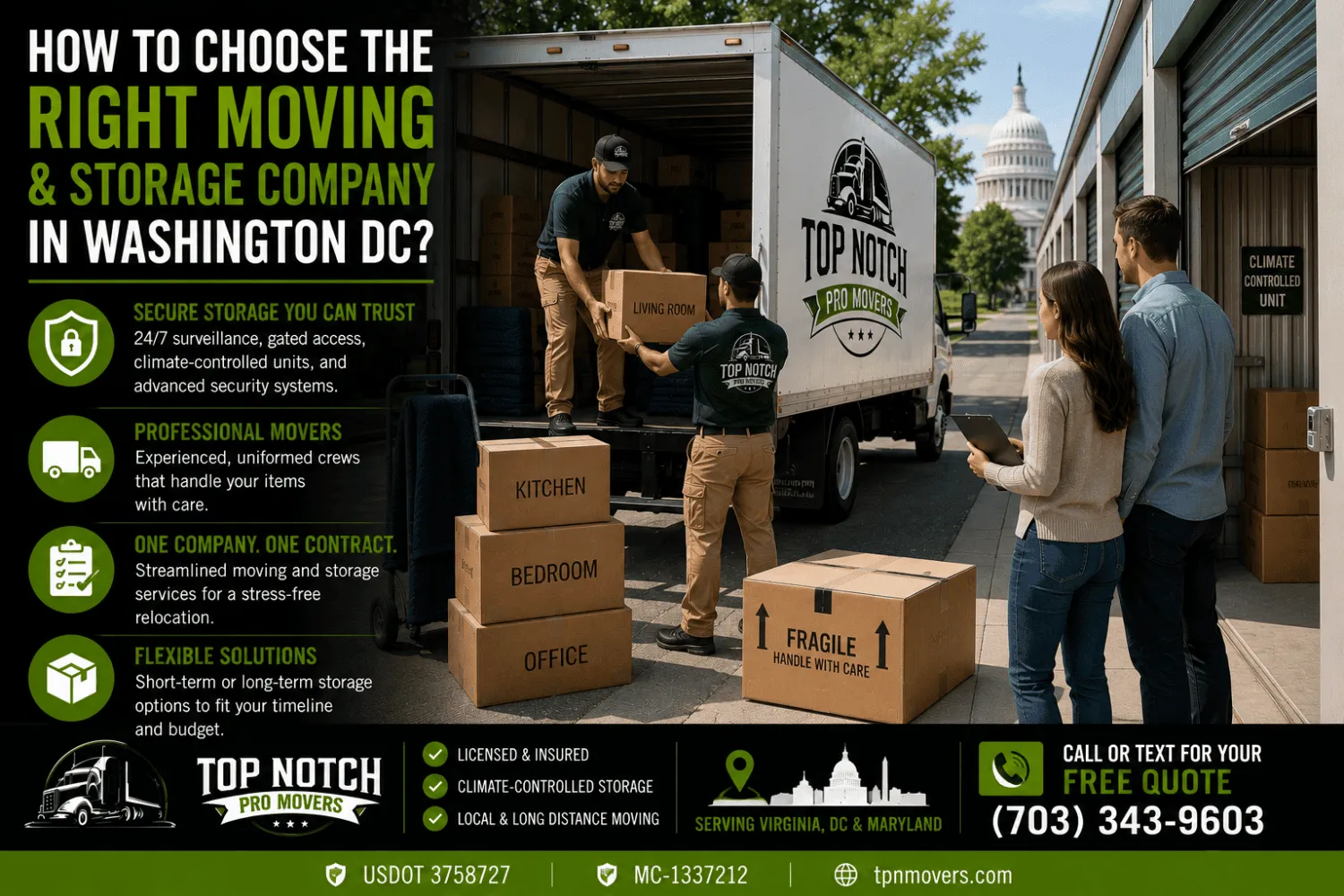
- Items are stored in a climate-controlled vault or truck at the carrier’s warehouse.
- You receive an inventory list of everything in storage.
- When you are ready, the carrier delivers directly to your new address.
- You handle the items once on move-in day — no second truck rental or additional labor needed.
What Is Self-Storage?
Self-storage is a facility-based model where you rent a unit — typically by the month — and manage access, loading, and transport yourself. The DMV has no shortage of options, with national chains like Public Storage, CubeSmart, and Extra Space Storage operating hundreds of locations across Northern Virginia, Maryland, and D.C.
The self-storage industry in the United States generates over 40 billion dollars annually, according to Statista. Availability is rarely the issue. The question is whether it is the right fit for the complexity of your move.
How Self-Storage Works
- You rent a unit directly from the storage facility on a monthly basis.
- You arrange transportation of your items to and from the unit.
- Access is typically available seven days a week during gate hours.
- You manage inventory, packing, and any additional labor needed.
- Items remain in the unit until you retrieve them at your own schedule.
Full-Service Storage vs. Self-Storage: Side-by-Side Comparison
| Feature | Full-Service Moving Storage | Self-Storage |
| Who handles transport | Moving company | You |
| Access to belongings | By appointment only | Anytime during gate hours |
| Labor required from you | None | All loading and unloading |
| Inventory tracking | Professional itemized list | Self-managed |
| Climate control | Standard with most carriers | Available at premium units |
| Insurance coverage | Often included in mover policy | Separate renter policy needed |
| Minimum commitment | Varies by carrier (often weekly) | Typically month-to-month |
| Best for | Full household or commercial moves | Long-term storage or partial loads |
Cost Breakdown: What to Expect in the DMV
Cost is where most people start their comparison, and it is also where the most confusion happens. Full-service storage typically feels more expensive on a per-week basis, but when you factor in the cost of renting a truck, hiring day laborers, and making multiple trips, the math often shifts.
Below is a general cost reference based on DMV market averages. These figures are estimates and will vary based on volume, duration, and specific provider.
| Storage Type | Estimated Monthly Cost (DMV) | Additional Costs to Factor |
| Full-Service (small home, 1-2 BR) | $300 – $600/month | Typically included in moving contract |
| Full-Service (large home, 3-4 BR) | $600 – $1,200/month | Redelivery fee may apply |
| Self-Storage (5×10 unit) | $80 – $150/month | Truck rental + labor + insurance |
| Self-Storage (10×20 unit) | $180 – $320/month | Truck rental + labor + insurance |
| Self-Storage (climate control add-on) | +$30 – $75/month | Varies by facility |
One factor that often surprises people in Northern Virginia and D.C. is the cost of truck rentals. A 26-foot truck in the DMV market can run $200 to $400 per day before fuel, mileage, and insurance. If you need to make two trips between a self-storage unit and your new home, that daily cost adds up fast.
Security and Insurance: A Critical Comparison
When your belongings are in someone else’s care, the question of liability matters. Full-service movers are required by federal law to offer two levels of liability coverage for interstate moves: Released Value Protection, which is the minimum coverage at 60 cents per pound per article, and Full Value Protection, which covers the repair or replacement cost of damaged items.
Self-storage facilities typically carry property insurance that covers the building structure, not your contents. Most facilities strongly recommend that renters obtain a separate storage unit insurance policy. According to the Insurance Information Institute, standard homeowners and renters insurance policies often include off-premises coverage, but limits and exclusions vary significantly. Review your existing policy before assuming your items are covered in a self-storage unit.
Which Option Fits Your Situation?
There is no universal answer here. The right choice depends on how long you need storage, how much you have to store, how often you need access, and how hands-on you want to be with the process.
| Your Situation | Recommended Option |
| Moving between homes with a 2-4 week gap | Full-Service Storage |
| Downsizing and keeping excess items long-term | Self-Storage |
| Military PCS or corporate relocation with tight timelines | Full-Service Storage |
| Remodeling and need storage for 3-6+ months | Self-Storage |
| Large commercial move with phased delivery | Full-Service Storage |
| College student storing during summer break | Self-Storage |
| Elderly person relocating to a smaller home | Full-Service Storage |
The DMV-Specific Considerations
The DMV market has a few regional realities that affect both storage options. Parking restrictions in D.C. and densely built Northern Virginia neighborhoods can make self-storage logistics more difficult than they appear. Moving a large truck to and from a storage unit in Arlington or Alexandria during weekday hours often requires permits, and access windows are limited.
Traffic in the corridor between D.C., Fairfax County, and Stafford County is among the worst in the country. The Texas A&M Transportation Institute’s Urban Mobility Report consistently places the Washington metro area in the top five for congestion. Every additional trip to a self-storage unit is a real-time commitment, not just a theoretical inconvenience.
Top Notch Pro Movers serves customers throughout this region and works with households and businesses to structure storage arrangements that account for these real-world constraints. The goal is to reduce the number of touch points your belongings require, which directly reduces both cost and risk of damage.
Climate and Your Belongings
The DMV climate is classified as humid subtropical, with summer temperatures regularly exceeding 90 degrees Fahrenheit and relative humidity pushing above 80 percent during July and August. This environment is not friendly to wood furniture, leather, electronics, artwork, or musical instruments.
If you are storing any of these items, climate control is not a luxury — it is a necessity. Full-service moving storage from established carriers typically includes climate-controlled vaulting as a standard offering. With self-storage, you need to specifically seek out and pay for a climate-controlled unit, and verify the facility’s temperature and humidity management standards before signing a lease.
Top Notch Pro Movers advises clients to always confirm climate control specifications in writing before committing to any storage arrangement, regardless of provider. Marketing language like “temperature managed” and “climate controlled” do not always mean the same thing, and the difference can matter significantly for sensitive items.
Questions to Ask Before You Commit
Whether you are leaning toward full-service or self-storage, ask these questions before signing anything:
For Full-Service Moving Storage
- Is the storage facility the moving company’s own warehouse, or a third-party location?
- What is the redelivery timeline and is there a redelivery fee?
- What liability coverage is included and what are the claim limits?
- Is the storage rate locked, or can it change during your storage period?
- Will the same crew that picked up your items handle redelivery?
For Self-Storage
- What is the gate access schedule and are there after-hours restrictions?
- Is the unit climate-controlled, and what are the temperature/humidity ranges maintained?
- What is the facility’s security infrastructure (cameras, gated access, on-site management)?
- Does your homeowners or renters insurance cover items stored off-premises?
- What is the lease structure — month-to-month or minimum commitment?
Making the Final Decision
The bottom line is straightforward. If your priority is convenience, speed, and minimizing the number of times your belongings are handled, full-service moving storage is the stronger choice. If your priority is cost savings over a longer period and you have the time and resources to manage logistics yourself, self-storage offers more flexibility.
For most families and businesses executing a move in the DMV, the gap period between homes or offices is short and stressful. Adding a self-storage layer to that period increases complexity. Top Notch Pro Movers consistently finds that clients who use storage-in-transit report fewer complications and arrive at their new location in better shape — physically and mentally — than those managing multiple logistics chains simultaneously.
Frequently Asked Questions
1. How long can I keep my belongings in full-service moving storage?
Most moving companies in the DMV allow storage-in-transit for 30 to 180 days. Some carriers accommodate longer periods, but extended storage typically involves a transfer to a permanent warehouse vault with a revised pricing structure. Confirm the specific terms with your carrier before your move-out date.
2. Is full-service moving storage available for local moves within Virginia or Maryland?
Yes. While storage-in-transit is commonly associated with interstate moves, most full-service movers offer the same service for local moves. If your closing is delayed or your new home needs renovation work before you move in, your mover can hold your items at their facility until you are ready.
3. Can I access my items while they are in full-service storage?
Access is typically limited and must be scheduled in advance. Moving company vaults are designed for secure holding, not regular retrieval. If frequent access to your belongings is important — for example, if you need to retrieve seasonal clothing or work equipment regularly — self-storage will serve you better for that specific need.
4. What size self-storage unit do I need for a three-bedroom home?
A standard three-bedroom home with typical furniture, boxes, and appliances generally fits into a 10×20 foot unit (200 square feet). If you have garage contents, outdoor furniture, or specialty items, you may need a 10×25 or 10×30 unit. Many storage facilities offer online size guides and phone consultations to help you estimate accurately before you commit.
5. Does homeowners insurance cover my belongings in a self-storage unit?
It depends on your specific policy. Many standard homeowners and renters insurance policies include off-premises coverage, but limits are often capped at 10 percent of your total personal property coverage. High-value items like jewelry, electronics, and art may have sub-limits or be excluded entirely. Review your declarations page and speak with your insurance agent before relying on existing coverage for items in self-storage.