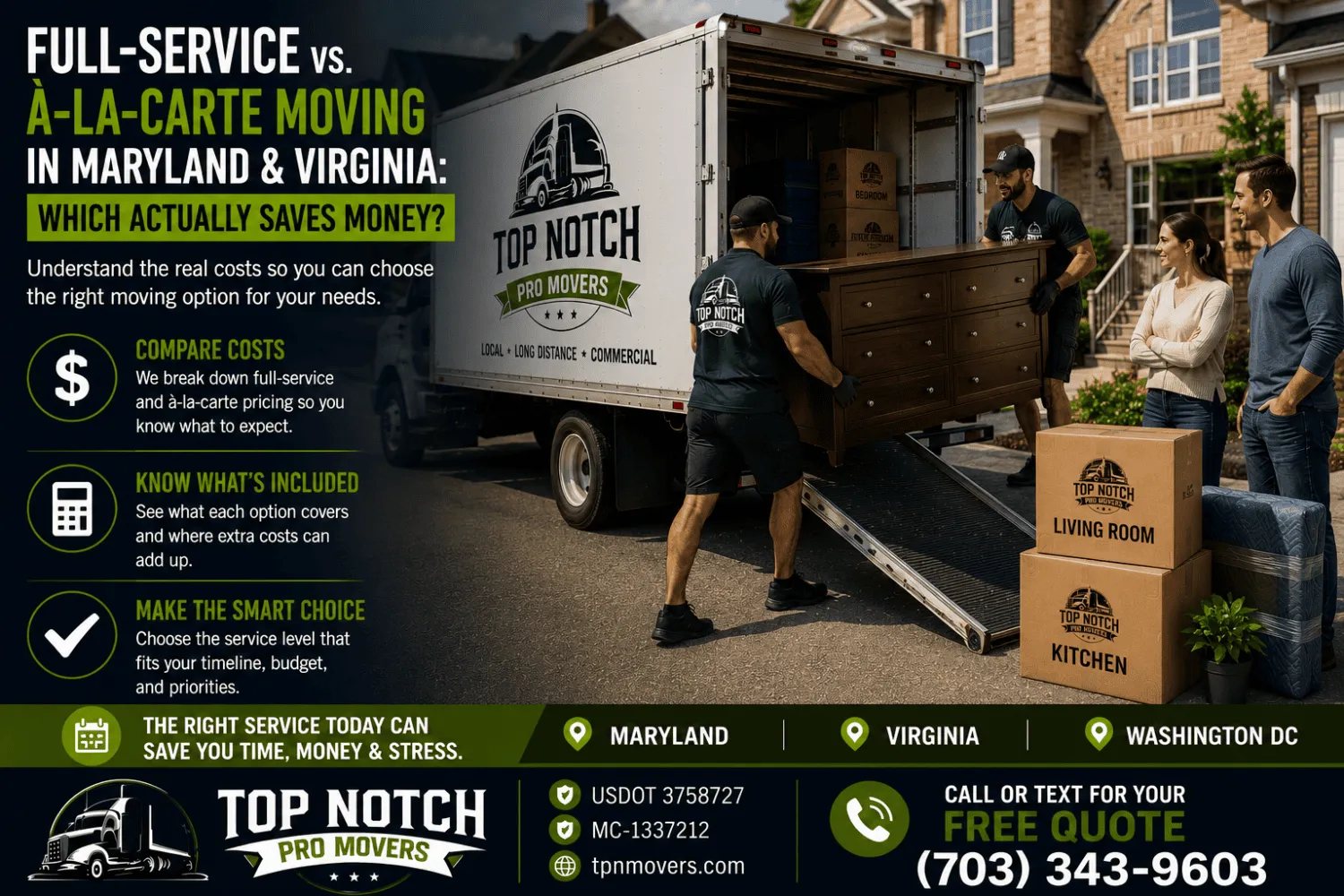


Whether you are relocating across Fairfax County or transitioning an office from Fredericksburg to Bethesda, one question shapes your entire budget: do you book a full-service move and let professionals handle everything, or do you pick and choose individual services to keep costs down? The answer is rarely as straightforward as it sounds. The moving market in Maryland and Virginia is competitive, regulated, and layered with variables that can swing your final invoice by thousands of dollars.
If you are working with a local moving company in Virginia for a residential transition, pricing looks very different than if you are coordinating a commercial relocation across county lines. Similarly, customers booking long distance movers in Virginia face a separate cost structure built around weight, mileage, and fuel rather than hourly crew rates. Even commercial movers in Virginia apply different pricing logic depending on whether a business needs full asset relocation or only specific services like furniture breakdown and IT equipment handling. Understanding what you are actually paying for is the first step toward making a decision that protects your budget.
This guide breaks down both models with real cost ranges, permit requirements, and a clear comparison so you can walk into your next estimate with a firm grasp of where money is saved and where it is spent.
What Is a Full-Service Move?
A full-service move is exactly what the name implies. The moving company handles every stage of the relocation: packing your belongings, supplying all materials, loading the truck, transporting your items, unloading at the destination, and unpacking on arrival. For many households, this is the most time-efficient option available.
According to recent industry benchmarking data, the national average cost across all move types and sizes is $3,020, while local full-service moves average $1,489 and long-distance full-service moves average $3,129 for a standard two- to three-bedroom household. In high-demand DMV metro markets like Northern Virginia, Maryland suburbs, and the Beltway corridor, those figures trend higher due to regional labor costs, urban access restrictions, and moving permit fees.
What Is an A-La-Carte Move?
An a-la-carte move, sometimes called a hybrid or labor-only move, allows you to select only the services you need. You might rent a truck independently and hire professional movers just for the heavy lifting, or you might book packing only for your fragile items while boxing the rest yourself. This model puts more of the physical work on you in exchange for lower labor costs.
The trade-off is real. A-la-carte moves require more coordination, more personal time, and they shift liability for packing errors onto you rather than the moving company. Items damaged during a move you partially packed yourself are generally not covered under the standard carrier liability policy that comes with full-service providers.
Cost Comparison: Full-Service vs. A-La-Carte in Maryland and Virginia
The table below reflects typical cost ranges for residential moves in the Maryland and Virginia market based on home size and service model.
| Home Size | Full-Service Move | A-La-Carte (Labor + Truck Rental) | DIY (Truck Rental Only) |
| Studio / 1-Bedroom | $800 – $1,500 | $450 – $850 | $200 – $450 |
| 2-Bedroom | $1,500 – $3,200 | $850 – $1,600 | $350 – $650 |
| 3-Bedroom | $3,000 – $6,500 | $1,400 – $2,800 | $500 – $900 |
| 4+ Bedroom | $6,000 – $12,000+ | $2,500 – $5,000 | $700 – $1,300 |
| Long-Distance (100+ miles) | $3,100 – $9,500+ | $2,000 – $5,500 | $900 – $2,500 |
Note: Costs vary based on move date, crew size, access conditions, and whether moving permits are required in your specific jurisdiction. Summer months and weekends carry higher demand surcharges across the DMV metro area.
Moving Permits in Maryland and Virginia: What You Need to Know
One of the most frequently overlooked cost variables in a Maryland or Virginia move is the moving permit. These are parking and access permits required for moving trucks to legally operate in certain jurisdictions, particularly urban and suburban areas where street parking is restricted.
In the Northern Virginia market, municipalities like Alexandria, Arlington, and Fairfax require moving truck parking permits in advance. Alexandria, for example, allows reserved spaces of up to 20 feet each, with a maximum of five spaces permitted per application. Failure to secure a permit can result in fines and, in worst cases, a towed truck mid-move.
In Maryland, requirements vary by county. Montgomery County uses an online permitting system that allows up to four parking spaces for a maximum of 16 hours. Moving trucks may park in residential areas for up to 48 hours without a permit only if they do not obstruct traffic, but most professional moves in densely populated areas require formal permits to avoid delays.
| Jurisdiction | Permit Required? | Application Method | Notes |
| Alexandria, VA | Yes | alexandriava.gov or in-person | Up to 5 spaces, 20 ft each |
| Arlington, VA | Yes | Online or County Office | Required for most residential streets |
| Fairfax County, VA | Varies by neighborhood | Fairfax County VDOT | Check HOA rules in addition |
| Montgomery County, MD | Yes | Online Permitting System | Up to 4 spaces, max 16 hours |
| Prince George’s County, MD | Varies | Municipal Office | Residential zones require confirmation |
| Stafford / Fredericksburg, VA | Generally Not Required | N/A | Confirm with city for downtown addresses |
Full-service moving companies typically absorb permit management into their operations. When you book a-la-carte or hire labor-only help, the responsibility for securing moving permits generally falls to you. Overlooking this step can delay your entire moving day and generate unexpected fines.
What Full-Service Actually Costs You in the DMV Market
Beyond the base quote, full-service moves in Maryland and Virginia often include several line items that appear only in the fine print. Knowing these in advance helps you compare quotes accurately.
| Add-On Service | Typical Cost Range | Included in Full-Service? |
| Professional Packing (whole home) | $200 – $1,000 | Yes (in most full-service packages) |
| Packing Materials (boxes, tape, wrap) | $50 – $200 | Yes |
| Furniture Disassembly / Reassembly | $50 – $300 | Yes |
| Long Carry Fee (over 75 feet) | $50 – $150 | Sometimes; confirm with provider |
| Stair Fee (per flight) | $25 – $75 per flight | Sometimes; confirm with provider |
| Storage (if needed) | $100 – $300/month | No; billed separately |
| Moving Permit Acquisition | $25 – $150 per permit | Yes (full-service); No (a-la-carte) |
| Valuation / Insurance Upgrade | $50 – $300+ | Basic liability included; full value extra |
When Full-Service Is the Better Financial Decision
Despite the higher upfront cost, full-service moving frequently ends up being the more economical choice when you factor in the full picture. Consider the following scenarios where the math favors full-service.
- You are moving a 3-bedroom or larger home where packing time alone would consume an entire weekend or more.
- You are relocating long-distance from Virginia to Maryland or beyond, where weight-based pricing replaces hourly rates and professional packing protects your goods through a longer transit.
- You or your household members have physical limitations that make hands-on participation difficult or risky.
- Your employer is covering relocation costs, making full-service the most efficient and well-documented option for reimbursement.
- You are moving valuable items such as antiques, pianos, or large artwork that require specialized handling included in full-service packages.
When A-La-Carte Moving Saves You Real Money
A-la-carte moving is genuinely the smarter financial call in the right circumstances. The key is being honest about how much time and physical capacity you have available.
- You are moving a studio or one-bedroom apartment with minimal heavy furniture.
- You are relocating locally within the same county and can handle most packing yourself over several evenings.
- You already have access to packing supplies or have done this before.
- You are moving on a flexible schedule and can maximize off-peak pricing by booking midweek or in the fall and winter months.
- Your building has easy access with no stair fees, long carries, or permit requirements that would generate add-on costs.
The Hidden Cost of Underestimating a DIY-Heavy Move
Industry data from HireAHelper, which analyzed more than 50,000 moves in 2024, found that local moving costs increased in 30 of 40 states measured, with continued price pressure expected through 2025 and 2026. More relevant to the Maryland and Virginia market is the cost of time. A 2025 survey tracking over 1,000 moving customers found the national average cost of a move exceeded $3,020 when all services were combined, but self-managed moves routinely exceeded that figure once damaged goods, missed workdays, and extra truck rental days were factored in.
The moving industry in the United States generated approximately $23.2 billion in revenue in 2024. The volume of demand, particularly in the competitive DMV corridor, means that even partial-service companies carry premium rates during peak season. An a-la-carte booking that looked like a deal in January may cost the same as a full-service move in July once surge pricing is applied.
Top Notch Movers: Service Options Built Around Your Budget
Top Notch Pro Movers operates in Virginia and Maryland with a service menu designed to match the financial and logistical reality of each customer. Rather than forcing every customer into a full-service package or leaving them to navigate the complexity of a partial move alone, Top Notch Movers provides transparent pricing across both service models so clients can make informed decisions before signing anything.
For customers weighing the full-service option, Top Notch Movers includes permit acquisition, furniture disassembly, professional packing, and full carrier liability in one consolidated quote. For customers who prefer a-la-carte service, Top Notch Movers offers labor-only bookings, load-only assistance, and packing-only service to complement truck rentals or POD shipments. The clarity of that structure eliminates the pricing ambiguity that causes most moving budget overruns.
Whether you are planning a residential relocation between Stafford and Bethesda or a commercial transition across multiple Northern Virginia locations, Top Notch Movers brings the operational consistency needed to keep moving day on schedule and on budget.
Frequently Asked Questions
Do I need a moving permit if I am using a professional moving company in Virginia?
In many Virginia jurisdictions, particularly Alexandria and Arlington, a moving truck parking permit is required regardless of whether you hire professionals. The difference is that full-service moving companies typically handle permit acquisition on your behalf as part of the booking process. If you are booking an a-la-carte or labor-only service, confirm with your provider whether permit coordination is included or whether you are responsible for securing it independently through the relevant municipal office.
What is the average cost difference between full-service and a-la-carte moving in the DMV area?
For a standard two-to-three bedroom residential move, full-service packages in the Maryland and Virginia market typically run between $3,000 and $6,500 depending on access conditions, distance, and seasonal demand. A-la-carte moves for the same home size generally range from $1,400 to $2,800 when labor costs and truck rental are combined. The gap narrows significantly when you account for packing time, add-on fees, and any permit costs that the a-la-carte customer must manage independently.
Are moving permits required in Maryland counties like Montgomery or Prince George’s?
Yes, in most urban and suburban areas of Montgomery County, Maryland, a moving truck parking permit is required and is obtained through the county’s Transportation Online Permitting System. The permit covers up to four parking spaces for a maximum of 16 hours. Prince George’s County requirements vary by municipality, so it is advisable to confirm with the relevant city or county office before moving day. Full-service companies are generally familiar with local permit requirements and handle this coordination for you.
Is a-la-carte moving a bad idea for long-distance moves from Virginia to another state?
Not necessarily, but it requires significantly more planning. Long-distance moves are priced by weight and mileage rather than hourly rates, which means truck rental costs rise sharply with volume. A three-bedroom long-distance move under 400 miles averages around $3,036 in total cost according to 2024 industry data. If you rent a truck independently and hire labor-only help, your out-of-pocket cost may be comparable after factoring in fuel, rental fees, moving permits along the route, and your own time. For moves over 500 miles, most customers find that a full-service or hybrid package from a licensed interstate carrier offers better value and accountability.
How do I know if a moving company in Virginia is properly licensed?
For intrastate moves within Virginia, movers must be registered with the Virginia Department of Motor Vehicles and hold a valid motor carrier operating authority. For interstate moves, the carrier must hold a USDOT number issued by the Federal Motor Carrier Safety Administration and a Motor Carrier number registered with FMCSA. Before booking any service, full-service or a-la-carte, verify the company’s credentials through the FMCSA online lookup tool and check for active complaints through the Better Business Bureau. The BBB recorded 723 complaints against moving companies in 2025 nationally, underscoring the importance of licensing verification before signing any contract.