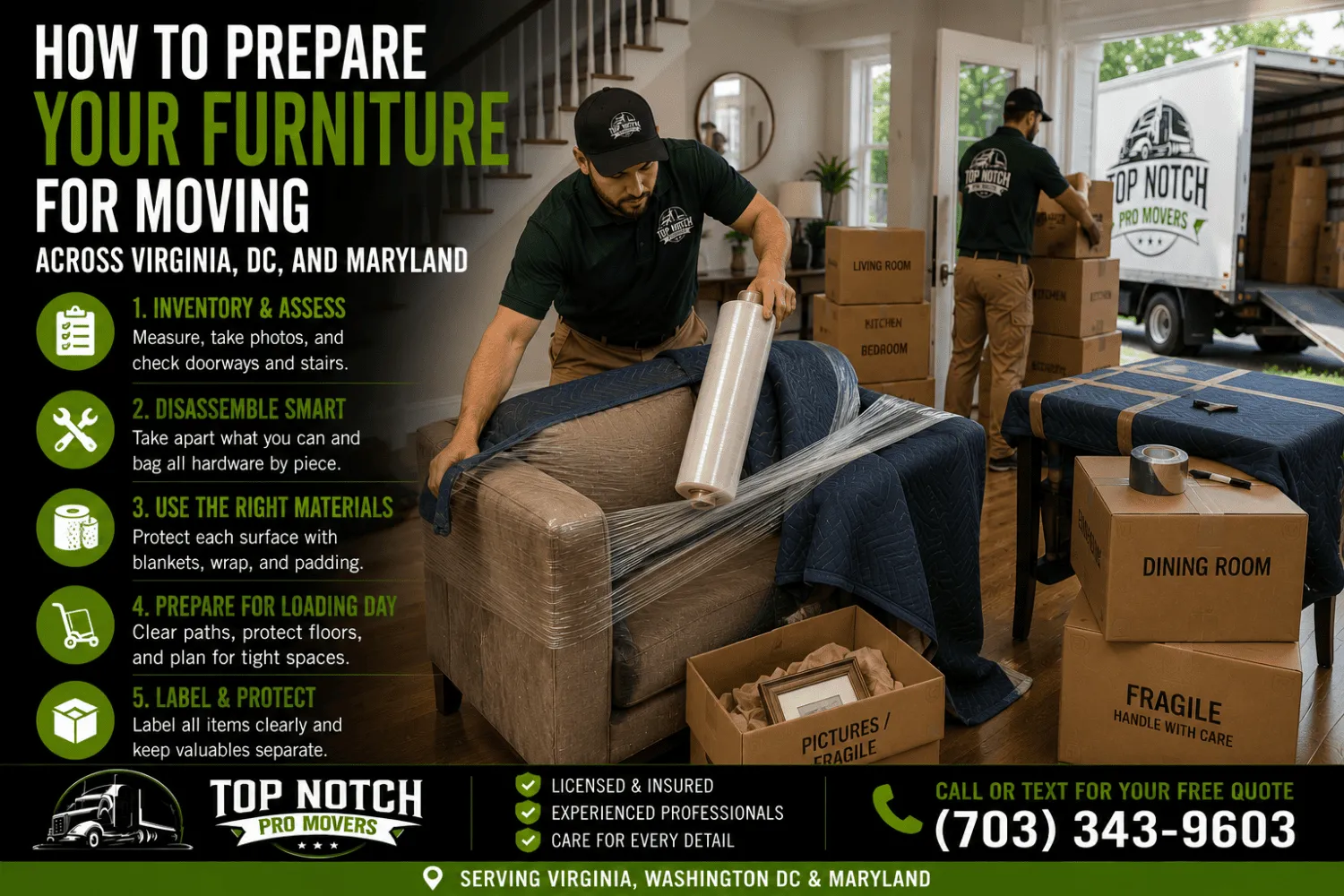


Moving furniture across state lines or even across a metro area is not a simple task. The Virginia, DC, and Maryland corridor is one of the most active relocation markets in the country. According to the U.S. Census Bureau, the Washington DC metro area consistently ranks among the top five regions for inbound and outbound moves, with hundreds of thousands of households relocating annually. Whether you are transitioning from a Northern Virginia townhouse to a Maryland suburb or moving an entire office from Fredericksburg to the District, how you prepare your furniture will determine how much of it survives the trip intact.
If you are working with a local moving company in Virginia, planning a commercial moving company in Virginia transition, or coordinating long distance moving in Virginia, the furniture preparation steps are largely the same but the stakes get higher the farther your items need to travel. Top Notch Pro Movers has handled thousands of moves throughout this region, and the guidance below reflects the kind of preparation that separates a clean delivery from a costly one.
Why Furniture Prep Is Not Optional
A lot of people pack their clothes and kitchen items with care, then drag the couch out the door without a second thought. That approach accounts for most of the furniture damage claims filed every moving season. The American Moving and Storage Association reports that furniture damage is the leading category of moving-related complaints in the United States, representing more than 40 percent of all claims submitted after a residential move.
The DMV corridor adds its own complications. Narrow rowhouse staircases in DC, low-clearance parking garages in Arlington, tight cul-de-sacs in Stafford County, and congested Route 1 corridors in Prince George’s County all create real logistical friction. Furniture that is not properly prepared for these conditions gets dinged, scratched, or broken during loading and transit regardless of how careful the crew is.
Step 1: Inventory and Assess Before You Pack
Before you pull out a single roll of stretch wrap, walk through every room and document your furniture. Take photos from multiple angles, note any pre-existing damage, and measure large pieces against doorways, stairwells, and elevator dimensions at both your current location and your destination.
For high-value items, antiques, or custom-built furniture, consider getting a written appraisal before the move. Most standard moving insurance policies cover furniture at depreciated value unless you purchase full replacement value coverage. Knowing what you have and what it is actually worth gives you negotiating leverage if something goes wrong.
Practical measurement checkpoints:
- Front door width at origin and destination
- Staircase width and clearance height
- Elevator interior dimensions if applicable
- Any 90-degree turns in hallways or landings
Step 2: Disassemble What Can Be Disassembled
Beds, dining tables, modular shelving, and sectional sofas are almost always easier to move in pieces. Disassembling reduces the risk of frame warping, leg snapping, and corner denting. It also makes loading faster and reduces the total cubic footage you are paying to transport.
Keep hardware organized by storing screws, bolts, and brackets in labeled zip-lock bags and taping those bags directly to the furniture piece they came from. Do not throw them in a general box. Reassembly becomes a guessing game when hardware gets mixed together, and missing a single bolt can make a bed frame structurally unsafe.
Common Furniture Disassembly Guide
| Furniture Type | Disassemble? | Key Components to Remove | Notes |
| Bed Frame | Yes | Headboard, footboard, side rails | Bag all hardware per piece |
| Sectional Sofa | Yes | Individual sections, legs | Wrap fabric sections separately |
| Dining Table | Yes | Legs, glass inserts if applicable | Bubble wrap glass inserts |
| Bookcase / Shelving | Yes | Shelves, back panels | Mark shelf positions |
| Dresser | Partially | Remove drawers, keep frame intact | Empty drawers before moving |
| Desk | Yes (large desks) | Legs, monitor arms, keyboard trays | Wrap corner edges |
| Armoire / Wardrobe | Yes | Doors, shelves, hanging rods | Doors break hinges easily |
| Coffee Table | Partially | Remove glass tops | Transport glass vertically |
Step 3: Use the Right Materials for Each Surface
Generic stretch wrap and newspaper are not universal solutions. Different furniture materials require different protection strategies. Upholstered pieces trap dirt and odors from newsprint. Hardwood and lacquered finishes scratch from loose plastic contact. Glass and mirror surfaces need layered edge protection, not just a sheet of bubble wrap tossed on top.
Furniture Material Protection Reference
| Material | Primary Protection | Secondary Layer | Common Mistake to Avoid |
| Hardwood / Stained Wood | Moving blankets | Stretch wrap over blankets only | Do not stretch wrap directly on bare wood |
| Upholstered Fabric | Furniture bags or plastic covers | Moving blankets on top | Avoid newsprint contact with fabric |
| Leather | Breathable furniture covers | Padding on high-contact points | Plastic causes condensation and cracking |
| Glass / Mirrors | Foam edge protectors + cardboard | Diagonal bracing in upright position | Never transport flat |
| Laminate / MDF | Bubble wrap on corners | Moving blankets | MDF expands with moisture |
| Metal / Steel | Moving blankets | Tape open mechanisms shut | Wrap edges to protect other items |
| Marble / Stone Tops | Custom crating recommended | Foam padding on all surfaces | Do not stack other items on top |
Step 4: Prepare for Loading Day Conditions
Virginia summers are brutal. Maryland humidity rivals coastal climates. DC loading zones have strict time windows. Your furniture preparation needs to account for the day-of realities of this region, not just the ideal conditions described in generic moving guides.
Wooden furniture is particularly vulnerable to humidity. Even a single afternoon in a hot, humid truck can cause drawers to swell and joints to loosen. If you are moving between June and September in the DMV area, ensure your furniture is as dry as possible before it goes on the truck. Do not move items stored in a damp basement or garage the night before loading.
For commercial moves, parking logistics are a separate challenge. Loading zones in DC and downtown Bethesda routinely require permits. Coordinate these at least ten business days in advance. Top Notch Pro Movers typically handles permit applications as part of their commercial move planning process, which significantly reduces day-of complications.
Step 5: Label and Protect High-Value Items Separately
Not all furniture deserves the same level of protection, and not all furniture claims are treated equally by moving companies. Under standard valuation, a moving company is liable for only 60 cents per pound per item under federal interstate moving regulations. A 50-pound antique armoire that costs $3,000 to replace would be covered for only $30 under that standard.
Identify your highest-value pieces before the move and either purchase declared value protection through your mover or purchase a standalone moving insurance policy. Items in this category should be documented with serial numbers or appraisal certificates, wrapped individually regardless of size, and loaded last when possible so they are accessible and not buried under other cargo.
Moving Coverage Options Comparison
| Coverage Type | Cost | Liability Per Item | Best For |
| Released Value (Basic) | Free | $0.60 per pound | Low-value household items |
| Full Value Protection | Varies by mover | Repair, replace, or cash settlement | Most residential moves |
| Third-Party Insurance | Separate premium | Up to declared value | Antiques, high-end furniture |
| Declared Value | Based on item value | Declared amount minus deductible | Individual high-value pieces |
Moving Across Virginia, DC, and Maryland: Regional Considerations
Each jurisdiction in the DMV corridor has its own quirks. Knowing them in advance prevents day-of surprises.
- Virginia: HOA rules in many Northern Virginia communities restrict moving truck access during certain hours. Confirm time windows with your building or neighborhood association before scheduling.
- Washington DC: Residential and commercial loading zones often require DDOT permits. Street parking for moving trucks is rarely available without advance coordination.
- Maryland: High-rise buildings in Montgomery County and Prince George’s County frequently require elevator reservations for moves. Book the service elevator at least two weeks out.
Top Notch Pro Movers operates daily across all three jurisdictions and maintains working relationships with building managers and permitting offices throughout the corridor. That institutional knowledge reduces friction on move day in ways that a newly hired crew simply cannot replicate.
Final Pre-Move Furniture Checklist
- Photograph all furniture from multiple angles before wrapping
- Measure all pieces against doorways and stairwells at both addresses
- Disassemble all beds, sectionals, and large shelving units
- Bag and label all hardware directly on the piece it came from
- Use material-appropriate protection for each furniture surface type
- Identify high-value items and confirm coverage type before move day
- Confirm parking permits and elevator reservations in advance
- Avoid moving furniture from humid storage areas on move day
Top Notch Pro Movers builds a pre-move walk through into their residential and commercial service packages specifically because furniture preparation decisions made before loading day account for the majority of successful, damage-free deliveries. Investing two to three hours in proper preparation is consistently less expensive than filing a claim afterward.
Frequently Asked Questions
1. How far in advance should I start preparing my furniture for a move across Virginia, DC, or Maryland?
For a standard residential move, begin furniture preparation at least one week before your scheduled move date. Large commercial moves or relocations involving significant quantities of high-value furniture benefit from two to three weeks of lead time. This window allows for disassembly, proper sourcing of packing materials, permit applications, and building coordination.
2. Is it worth hiring professional packers to handle furniture wrapping, or can I do it myself?
It depends on the volume and value of your furniture. For standard household items, a well-prepared DIY approach using quality moving blankets, stretch wrap, and foam edge protectors is sufficient. For antiques, custom pieces, or a full-home move with dozens of furniture items, professional packing pays for itself in time saved and damage prevented. Many moving companies in the DMV corridor offer partial packing services where crews handle only the large furniture while you manage boxes.
3. What should I do with furniture that I am not sure will fit at my new location?
Measure before you commit to moving it. If a piece will not fit through the entrance or will not work in the new space, selling or donating it before your move date is almost always cheaper than paying to transport, store, and eventually dispose of it later. Donation pickups from organizations like Habitat for Humanity ReStores are free and can often be scheduled within a week.
4. Are moving blankets and stretch wrap sufficient for protecting wood furniture during a long-distance move?
For most hardwood furniture, moving blankets applied first and stretch wrap applied over the blankets provide adequate protection for long-distance moves. The key is ensuring the stretch wrap never contacts bare wood directly, as it can trap heat and moisture, softening finishes and causing adhesion marks. Particularly delicate or high-gloss finishes should also receive foam corner protectors or cardboard edge guards before blanketing.
5. What is the most common furniture mistake people make during DMV-area moves?
Underestimating the access challenges at the destination. Most preparation focuses on the origin, but a significant number of furniture damage incidents happen during off-loading when crews are navigating unfamiliar staircases, tight hallways, or low-clearance garages under time pressure. Walk through your destination address in detail before move day, confirm all measurements, and communicate any potential problem areas to your moving crew in advance so they can bring the right tools and plan the unload sequence accordingly.