

Moving into a new home is an exciting milestone, but the logistics of packing up your entire life and transporting it to a new location can be incredibly taxing. According to data from the U.S. Census Bureau, roughly 27 million Americans relocate in a single year, with residential moves making up the vast majority of this activity. In a geographically diverse state like Maryland, a residential move might mean navigating the historic, narrow streets of Annapolis, handling parking logistics in downtown Baltimore, or coordinating a suburban transition in Montgomery County.
To protect your household goods and your budget, hiring professional help is often the best route. Whether your upcoming transition requires a trusted local moving company to manage a quick neighborhood shift or specialized long distance movers to transport your family across state lines, vetting your options thoroughly is paramount. Companies like Top Notch Pro Movers emphasize that the more transparent your communication is during the initial consultation, the lower the risk of moving-day friction.
Before signing a contract with a residential moving company in Maryland, be sure to ask these critical questions during the estimate process.
1. Are You Properly Licensed to Operate in Maryland?
Licensing requirements vary depending on how far you are moving. If you are relocating within the borders of Maryland, local moving companies are regulated by the Maryland Public Service Commission (PSC) or local county agencies. For instance, moving companies operating within Montgomery County must hold a specific intra-state license.
If your move crosses state lines (e.g., moving from Bethesda to Northern Virginia or Washington, D.C.), the company must be registered with the Federal Motor Carrier Safety Administration (FMCSA) and possess an active USDOT number. Asking for these credential numbers upfront allows you to verify their legitimacy on official government databases.
2. Is Your Moving Estimate Binding or Non-Binding?
Understanding the exact nature of your moving quote is vital for avoiding unexpected invoice changes on delivery day. Moving companies generally offer three types of estimates:
- Non-Binding Estimate: A rough approximation of what your move might cost based on a cursory glance. The final price can fluctuate significantly based on the actual weight of your items or the exact hours worked.
- Binding Estimate: A guaranteed flat rate that ensures you pay exactly what is quoted, provided you do not add extra items or request additional services after the fact.
- Binding Not-to-Exceed Estimate: The most consumer-friendly option. It ensures you will not pay more than the original quote, but if your shipment weighs less than estimated, you pay the lower amount.
3. What Valuation Coverage Do You Offer for Damaged Items?
Statistically, the leading cause of consumer complaints in the relocation industry involves disputes over damaged or broken items. By default, standard moving contracts include Released Value Protection at no additional charge. However, this only covers your belongings at a meager 60 cents per pound per article. If a 10-pound high-end television is damaged, you would only receive $6.00 in compensation.
Always ask if the company offers Full Value Protection. Under this option, the mover is liable for the replacement value of lost or damaged items in your shipment.
Understanding Residential Service Tiers
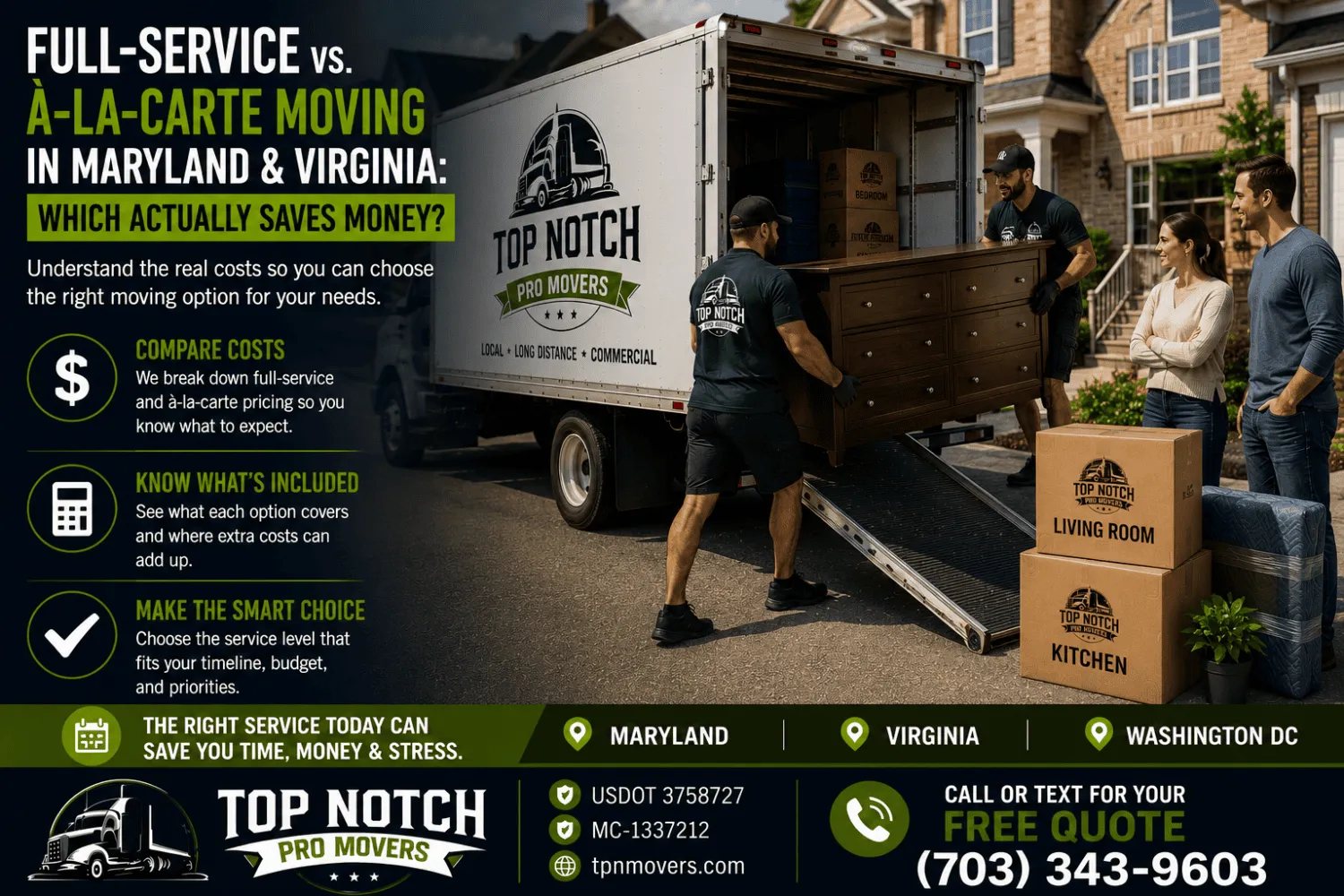
To help you evaluate different levels of service, it helps to look at how basic independent crews compare to premium full-service relocation companies like Top Notch Pro Movers:
| Feature/Service Metric | Basic In-and-Out Movers | Full-Service Residential Specialists |
| Packing & Materials | Provided entirely by the homeowner | Custom crating, wardrobe boxes, and full packing services |
| Valuation Protection | Often limited to basic 60¢/lb protection | Multiple options, including Full Value Protection |
| Liability Insurance | Minimum state requirements | Comprehensive liability coverage with direct COI generation |
| Scheduling Reliability | Loose arrival windows; susceptible to delays | Dedicated arrival time slots and tracked transit |
| Disassembly Services | Charges extra for beds and basic tables | Standard disassembly and reassembly of large furniture |
4. Are There Any Potential Hidden Fees Unique to My Home Layout?
Many homeowners are hit with surprise fees because they did not clarify what counts as an “auxiliary service.” When describing your home to an estimator, ask if they charge extra for:
- Long-Carries: If the moving truck cannot park close to your front door and the crew has to carry items a long distance.
- Flight Charges: Additional fees for navigating multiple flights of stairs if an elevator is unavailable.
- Shuttle Services: If a massive tractor-trailer cannot fit down a narrow historic street, requiring a smaller box truck to shuttle items back and forth.
5. Do You Subcontract Your Labor or Use Temporary Workers?
Some larger brokerages book your move and then sell the contract to a third-party local mover. To maintain quality control, look for an established company like Top Notch Pro Movers that utilizes its own background-checked, trained, and uniformed employees. Knowing who will actually be stepping inside your home gives you peace of mind regarding the safety of your family and your belongings.
Frequently Asked Questions (FAQs)
Q1: How early should I schedule a residential move in Maryland? A: It is best to secure your moving date 4 to 6 weeks in advance. If you are moving during the peak summer season (May through September) or right at the end of the month, booking even earlier is recommended as schedules fill up rapidly.
Q2: Will Maryland movers pack my belongings, or do I need to do it myself? A: Most residential companies offer flexible options. You can opt for a self-pack move to save money, a partial pack (where they only handle fragile items like glassware and electronics), or a full-service pack where the moving crew packs and unpacks everything.
Q3: Can a residential moving company transport my household plants across state lines? A: If you are moving locally within Maryland, transport is usually fine. However, if you are moving long-distance out of state, many federal and state agricultural regulations prevent commercial movers in Virginia from transporting live plants due to the risk of spreading pests.
Q4: What should I do with my highly valuable items like jewelry, passports, and prescription medications? A: You should always pack and transport high-value personal items, irreplaceable family heirlooms, important legal documents, and daily medications yourself. Keep these in your personal vehicle on move day so they never leave your chain of custody.
Q5: How do moving companies handle bad weather on moving day? A: Professional Maryland movers are accustomed to handling seasonal weather changes, from humid summer rain to winter snow. They typically utilize protective floor runners, plastic stretch wrap for furniture, and heavy-duty tarps to keep your belongings dry and your old and new homes clean.
Final Thoughts
Choosing a residential moving company does not have to be a game of chance. By taking a proactive approach and asking these targeted questions, you can cut through vague sales pitches and find a provider that offers genuine transparency and care. Taking the time to vet your movers ensures your transition into your new Maryland home is smooth, predictable, and remarkably stress-free.