

Moving a household is already a logistical challenge. Moving one that includes a 19th-century armoire, a baby grand piano, or a signed original oil painting is an entirely different operation. Across the Tri-State Area — covering Virginia, Maryland, and Washington, D.C. — the combination of dense urban corridors, strict parking regulations, building access restrictions, and state-level moving permits requirements can turn an already high-stakes task into a minefield for the unprepared.
Whether you are relocating from a suburban home in Stafford County to a condominium in the District, or transitioning a family estate across state lines, the handling of irreplaceable possessions demands a level of precision that general household movers are rarely equipped to provide. The stakes are real: the American Moving and Storage Association estimates that over 40 million Americans move each year, and a significant percentage of damage claims involve specialty items that were mishandled due to inadequate preparation or the wrong choice of mover.
This guide is built for homeowners, collectors, estate managers, and anyone who has ever looked at a prized possession and wondered how it could possibly survive the transit. The information below covers everything from item-specific handling protocols to the permit landscape across Virginia, Maryland, and D.C.
If you are looking for a trusted local moving company in Virginia with specialty capabilities, or need long distance movers in Virginia for an interstate estate relocation, or require the services of experienced commercial movers in Virginia for an office with high-value equipment and antique decor, the right preparation starts well before moving day. Top Notch Movers serves clients across this entire region with the tools and training to handle what most movers cannot.
Why High-Value Items Demand a Completely Different Approach
The moving industry operates on weight, volume, and distance as its primary pricing and planning variables. High-value items break that model entirely. A 500-pound antique secretary desk may weigh the same as five modern flat-pack pieces, but the handling requirements are entirely incomparable. Wood that has been joined, carved, and finished over a century ago cannot tolerate the same compression, vibration, or temperature exposure that a modern particle-board unit can absorb.
Pianos present their own category of challenge. According to piano manufacturers and relocation specialists, even a modest upright piano contains over 12,000 individual parts, many of them under significant string tension. The structural integrity of the instrument depends on maintaining balance during movement. Tilting, dropping, or rolling a piano incorrectly can detune it permanently, crack the soundboard, or damage the pin block in ways that cost thousands of dollars to repair — if repair is even possible.
Fine art and antiques carry the added dimension of provenance and appraised value. Once damaged, a piece may lose not just its aesthetic appeal but its certificate of authenticity, its historical record, and its market value. Insurance claims can recover financial losses, but they cannot restore the irreplaceable.
High-Value Item Risk and Handling Reference
| Item Type | Risk Level | Special Requirement | Estimated Add-On Cost |
| Antique Furniture | High | Custom crating, blanket wrap | $150–$500 per piece |
| Upright Piano | Very High | Piano board, strap system | $250–$600 |
| Grand Piano | Extreme | Lid removal, full crating | $500–$1,500+ |
| Fine Art / Paintings | High | Climate wrap, flat transport | $100–$800 per piece |
| Chandeliers / Glass | Very High | Individual boxing, foam lining | $75–$400 per item |
| Wine Collections | Medium–High | Temperature-controlled vehicle | $100–$300 per shipment |
Understanding Moving Permits in the Tri-State Area
One of the most overlooked aspects of moving high-value or oversized items through the Tri-State Area is the permit requirement. Moving permits — formal authorizations issued by local governments or transportation departments — are required any time a moving truck needs to occupy a parking lane, block a sidewalk, or park in a no-standing zone for an extended period during a residential or commercial move.
In Washington, D.C., the District Department of Transportation (DDOT) requires a Street Use Permit for most large residential moves, particularly in areas with limited parking or where a truck would need to stage equipment on public property. Failing to secure this permit can result in fines, towing of the moving vehicle, and significant delays on moving day — at exactly the moment when time is most critical.
In Virginia, permit requirements vary by municipality. Northern Virginia jurisdictions including Arlington, Alexandria, and Fairfax County each have their own processes, and urban high-rises frequently require a certificate of insurance naming the building as an additional insured before a moving crew is even allowed to load or unload. In Maryland, Montgomery County and Prince George’s County apply similar requirements in densely populated areas.
The key takeaway is this: permit requirements are not optional, and they are not the mover’s problem to solve unless the mover is experienced enough to handle them on your behalf. When evaluating moving companies for high-value relocations, ask directly whether they manage permit applications as part of their service. A professional operation will handle this as a matter of standard practice, not as an aftercharge.
Moving Permits by State and Jurisdiction — Quick Reference
| State / Jurisdiction | Permit Required | Who Issues It | Lead Time | Typical Cost |
| Washington, D.C. | Yes (Street Use Permit) | DDOT | 3–10 business days | $50–$200+ |
| Virginia (urban areas) | Often Required | Local municipality | 2–7 business days | $25–$150 |
| Maryland | Varies by county | County/City DOT | 2–5 business days | $30–$100 |
| NYC Metro (nearby) | Yes (COI + Permit) | Building & DOT | 5–14 business days | $75–$500+ |
Packing Protocols That Actually Protect What Matters
There is a significant difference between packing for protection and packing for transport. For everyday items, the goal is to prevent breakage and scratching during a move that may involve a few stops and a few hours on the road. For antiques, pianos, and fine art, the goal is to create an environment within the packaging itself that mimics the stable conditions of the item’s permanent home.
Antique Furniture
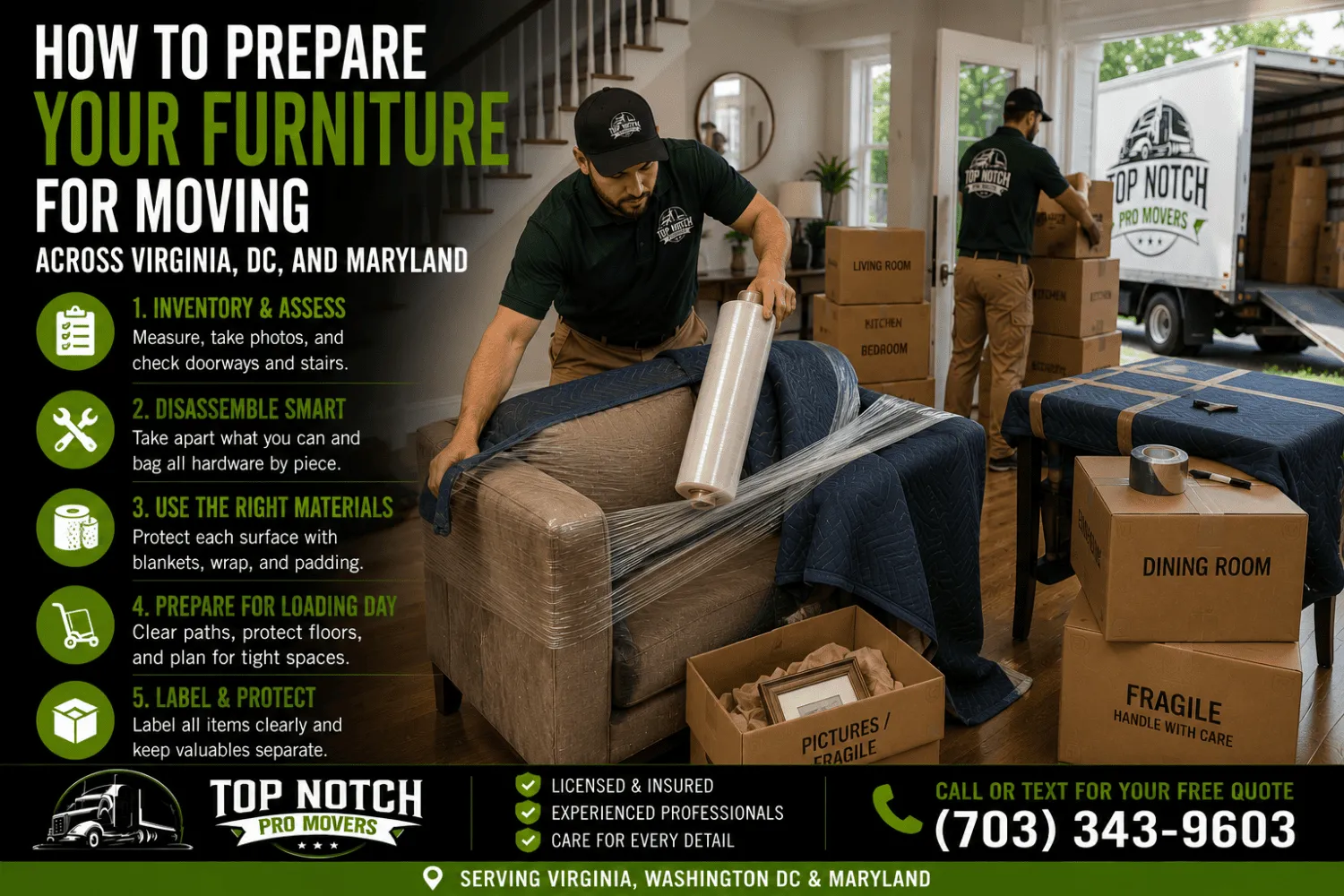
Remove all drawers and pack them separately. Hardware — hinges, knobs, handles — should be wrapped individually and placed in labeled bags taped to the interior of the piece they belong to. Veneered surfaces require specific padding materials that will not trap moisture, as humidity changes between the pickup and delivery location can cause bubbling or separation. Custom crating is advisable for any piece appraised above $2,500.
Pianos
Piano relocation should only be performed by crews trained specifically in piano moving. The instrument must be secured to a piano board, a rigid platform with straps designed to distribute the weight evenly and prevent the keyboard from bearing load during transit. Grand pianos require lid removal before movement. The pedal lyre and legs are removed and wrapped separately. The exposed finish must be protected with padded blankets secured without tape contact to any lacquered surface.
Fine Art and Framed Works
Framed artwork should be packed in mirror boxes — double-walled corrugated containers sized for the piece — with corner protectors applied before boxing. Canvases are particularly vulnerable to puncture and should never be stacked face-to-face without acid-free interleaving. Humidity control during transit matters for any work on panel or canvas, as wood and fabric respond dramatically to moisture changes during summer and winter moves in the Mid-Atlantic climate.
Insurance: What Your Policy Likely Does Not Cover
Standard homeowner’s insurance policies typically exclude items in transit unless you have specifically added a moving rider or scheduled personal property coverage. The federal government’s valuation options for licensed interstate movers — released value protection at $0.60 per pound per article and full-value protection — represent the floor and ceiling of carrier liability, but neither is adequate on its own for items of significant appraised value.
Released value protection is essentially no protection for high-value items. A 100-pound antique chair worth $4,000 would be compensated at $60 under released value terms. Full-value protection requires the carrier to repair, replace, or pay the current market value of damaged goods, but the carrier’s assessment of current market value may differ substantially from an appraiser’s documented figure.
The practical solution is a third-party fine art and specialty moving insurance policy, obtained either through your insurance broker or through a specialty carrier that works with the moving company. Obtain independent appraisals on all items valued above $1,000 before moving day, and retain those documents separately from the items themselves during the move.
DIY vs. Professional: An Honest Comparison
The temptation to save money by handling specialty items within a general move is understandable, particularly when moving costs are already significant. However, the risk-reward calculation changes completely when irreplaceable or high-value items are involved.
| Factor | DIY Move | Professional Specialty Movers |
| Equipment | Standard moving blankets only | Custom crates, piano boards, climate wrap |
| Insurance Coverage | Minimal / none for valuables | Full-value protection available |
| Permit Handling | Owner’s responsibility | Coordinated by mover |
| Liability on Damage | Full loss borne by owner | Carrier liable under filed tariff |
| Resale / Appraisal Value Impact | High risk of depreciation | Low risk with proper handling |
| Recommended For | Everyday household items | Antiques, pianos, fine art, collectibles |
The table above reflects what experienced movers and insurance professionals observe consistently: the cost of professional specialty handling is almost always lower than the cost of a single major damage claim, and far lower than the cost of permanent loss.
Choosing the Right Mover for High-Value Relocations
Not all licensed movers are equipped to handle specialty items, and the Tri-State Area market includes a wide range of companies with equally wide-ranging capabilities. When vetting a mover for antiques, pianos, or fine art, ask the following questions directly:
- Do you have crews specifically trained in piano relocation and antique handling?
- Can you provide references from clients who moved similar items in this region?
- Do you manage moving permit applications as part of your service?
- What full-value protection options do you offer, and how are claims assessed?
- Do you use custom crating in-house, or do you subcontract specialty packaging?
Top Notch Movers has built its operational model around these exact standards across Virginia, Maryland, and the District. Each crew member is trained on the specific handling requirements for the item types most commonly moved in this region, and the company maintains direct relationships with permitting offices in the jurisdictions where moves most frequently occur.
For long-distance estate relocations or multi-stop moves involving collections split across properties, Top Notch Movers coordinates the full scope of logistics, from access scheduling at origin and destination to temperature-controlled transport options for climate-sensitive pieces.
Practical Moving Day Checklist for High-Value Items
- Photograph every high-value item before the crew arrives, from multiple angles.
- Have appraisal documents accessible, not packed.
- Confirm permit status for both origin and destination addresses at least 48 hours in advance.
- Walk the crew through each specialty item before loading begins, and note any pre-existing damage in writing on the inventory sheet.
- Maintain climate control at origin until the last possible moment for temperature-sensitive pieces.
- Do not allow irreplaceable items to be loaded on the truck the night before a move if the vehicle will be parked outdoors in extreme weather.
- At delivery, inspect every specialty item before signing any completion paperwork.
Top Notch Movers incorporates a structured pre-move walk through for all specialty item relocations, ensuring that both the client and the crew have a shared, documented understanding of the condition and handling requirements of every piece before it is touched.
Frequently Asked Questions
1. Do I need a moving permit if I am moving within the same city?
It depends on the city and your specific address. In Washington, D.C., a street use permit is typically required for any move where a truck must stage in a parking lane or occupy public space, even for local moves. In Virginia and Maryland, requirements vary by municipality. Your mover should assess the permit situation at both origin and destination addresses during the booking process.
2. How far in advance should I book a mover for antiques or a piano?
For specialty items in the Tri-State Area, booking four to six weeks in advance is the minimum recommended lead time. This allows time for a proper in-home assessment, custom crating fabrication if needed, permit applications, and coordination with building management at origin and destination. For estate-level moves or those involving large collections, eight to twelve weeks is more appropriate.
3. Can a standard moving company move my piano, or does it require a specialist?
A licensed general mover can legally transport a piano, but that does not mean every mover has the equipment or training to do it safely. Piano relocation requires specific hardware — piano boards, leg dollies, hump straps — and crews who understand how to navigate stairs, elevators, and tight corridors without compromising the instrument’s structural integrity. Always ask about specific piano moving experience and references before booking.
4. What happens if my antique is damaged during the move?
If you are working with a licensed interstate carrier, the carrier is liable under the valuation option you selected at booking. Under full-value protection, the carrier must repair, replace, or compensate at current market value. However, the carrier’s market value assessment may differ from your appraiser’s figure. This is why independent pre-move appraisals and third-party specialty moving insurance are both advisable for items of significant value. Document everything before and after the move.
5. Is there a minimum value threshold for items that require specialty handling?
There is no universal threshold, but as a practical guideline, any item appraised above $1,000 that has structural, mechanical, or historical characteristics that make it non-replaceable in kind should receive specialty handling. This includes most antique furniture, all pianos regardless of size, original artwork, and any item for which a comparable replacement would require significant time, cost, or sourcing effort. When in doubt, err on the side of more protection rather than less.
Final Thoughts
Moving antiques, pianos, and high-value items across the Tri-State Area is not simply a bigger version of a standard household move. It is a different operation entirely, governed by different rules around permits, insurance, handling, and logistics. The difference between a successful specialty move and a costly failure almost always comes down to preparation and the choice of mover.Treat moving permits as a non-negotiable item on your pre-move checklist, invest in independent appraisals before moving day, and choose a company whose training and equipment match the value of what you are entrusting them to protect. Top Notch Movers brings the operational discipline and specialty expertise that high-value relocations across Virginia, Maryland, and Washington, D.C. demand.