

Top Questions to Ask a Moving Company in Virginia Before Office Shifting
Relocating an entire office layout is an entirely different operational puzzle than moving a residential household. While residential moves focus on personal comfort and sentimental items, corporate relocation centers around minimizing operational downtime, safeguarding sensitive IT infrastructure, and maintaining business continuity. According to industry data, corporate relocations account for approximately 16.4% of all professional moves in the United States annually. However, because an unorganized office move can result in costly productivity gaps, selecting the right commercial moving partner is paramount for your business survival during the transition.
If your organization is operating in the Commonwealth and preparing for a corporate transition, finding a credentialed and reliable Moving Company in Virginia is your first step toward success. Whether your strategy involves hiring a specialized Local moving company to cross town or securing corporate Long Distance Movers to cross state lines, conducting thorough due diligence before signing a contract will save your firm thousands of dollars in lost billable hours. Experienced providers like Top Notch Pro Movers understand that commercial clients require exact timelines and strict security protocols to execute a shift successfully.
To help you vet potential partners effectively, we have compiled a definitive list of critical questions you should pose to commercial movers during the initial consultation phases.
1. Do You Have Specific Experience with Commercial Relocations?
Residential and commercial shifting are distinct specialties. You need to verify that your chosen mover possesses a proven track record handling corporate spaces. Commercial movers must navigate strict property management rules, service elevators, loading dock scheduling, and specialized office furniture disassembly. Request references from businesses similar in size to yours that they have relocated over the last 12 months.
2. How Do You Minimize Business Downtime?
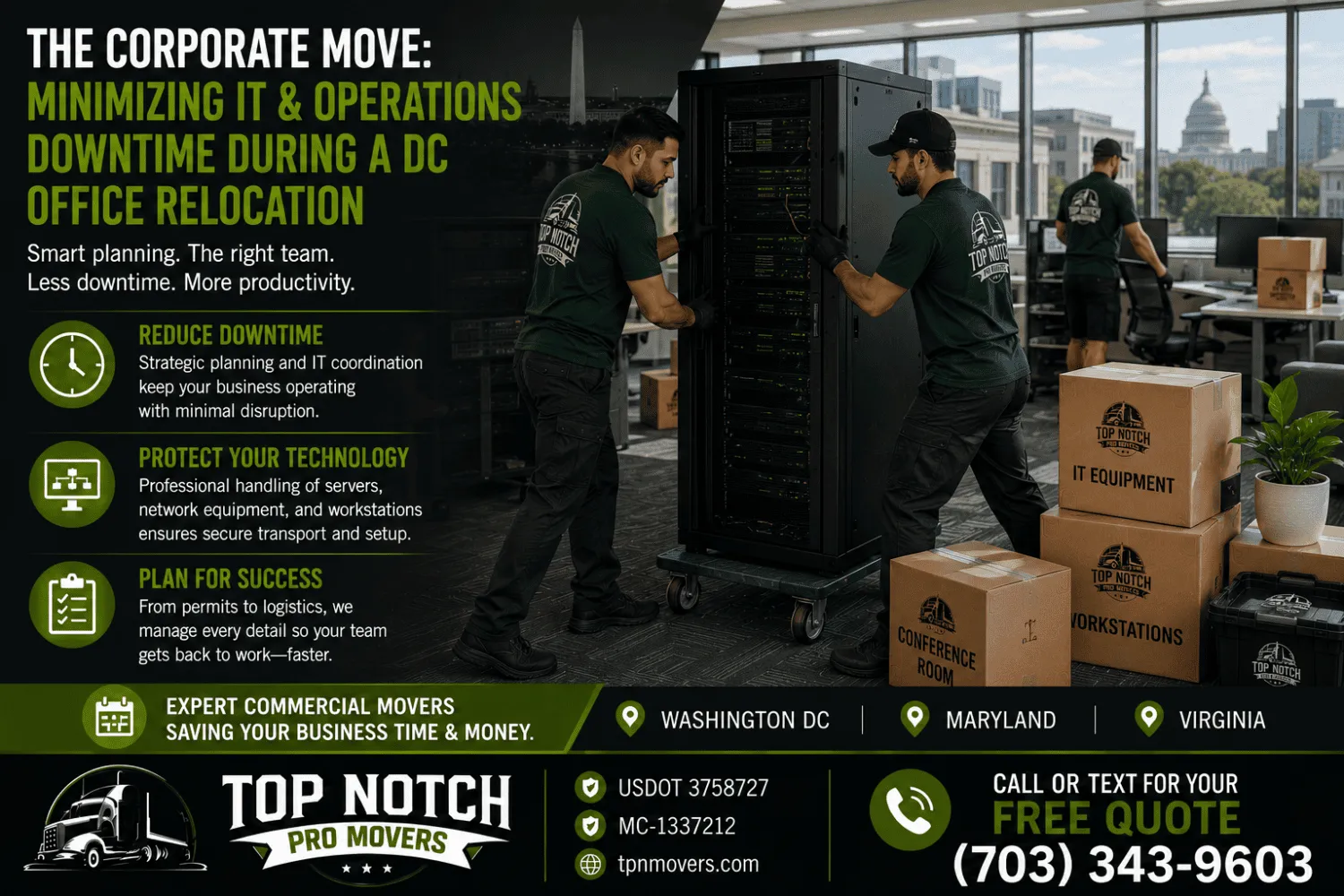
In the corporate landscape, time is quite literally money. According to commercial real estate statistics, unplanned operational downtime during a business move costs medium-sized companies an average of $3,000 to $7,500 per day in lost productivity. A premier commercial mover should offer flexible scheduling options, including overnight, weekend, or after-hours logistics, allowing your employees to leave work on Friday afternoon and return to an active, fully operational desk setup on Monday morning.
3. What Kind of Insurance and Valuation Coverage Do You Provide?
Basic moving quotes generally include the standard, federally mandated Released Value Protection, which only covers a meager 60 cents per pound per article. For expensive items like server racks, high-end workstations, and multi-functional printers, this coverage is severely inadequate. You must ask about Full Value Protection options or certificate of insurance (COI) provisioning, which is almost universally required by commercial property managers in Virginia business districts like Arlington, Reston, and Richmond.
Key Moving Statistic: Research indicates that up to 22% of corporate moves involve some level of minor damage to electronic infrastructure or modular furniture when standard residential movers are utilized instead of certified commercial specialists.
4. How Are IT Infrastructure and Sensitive Documents Managed?
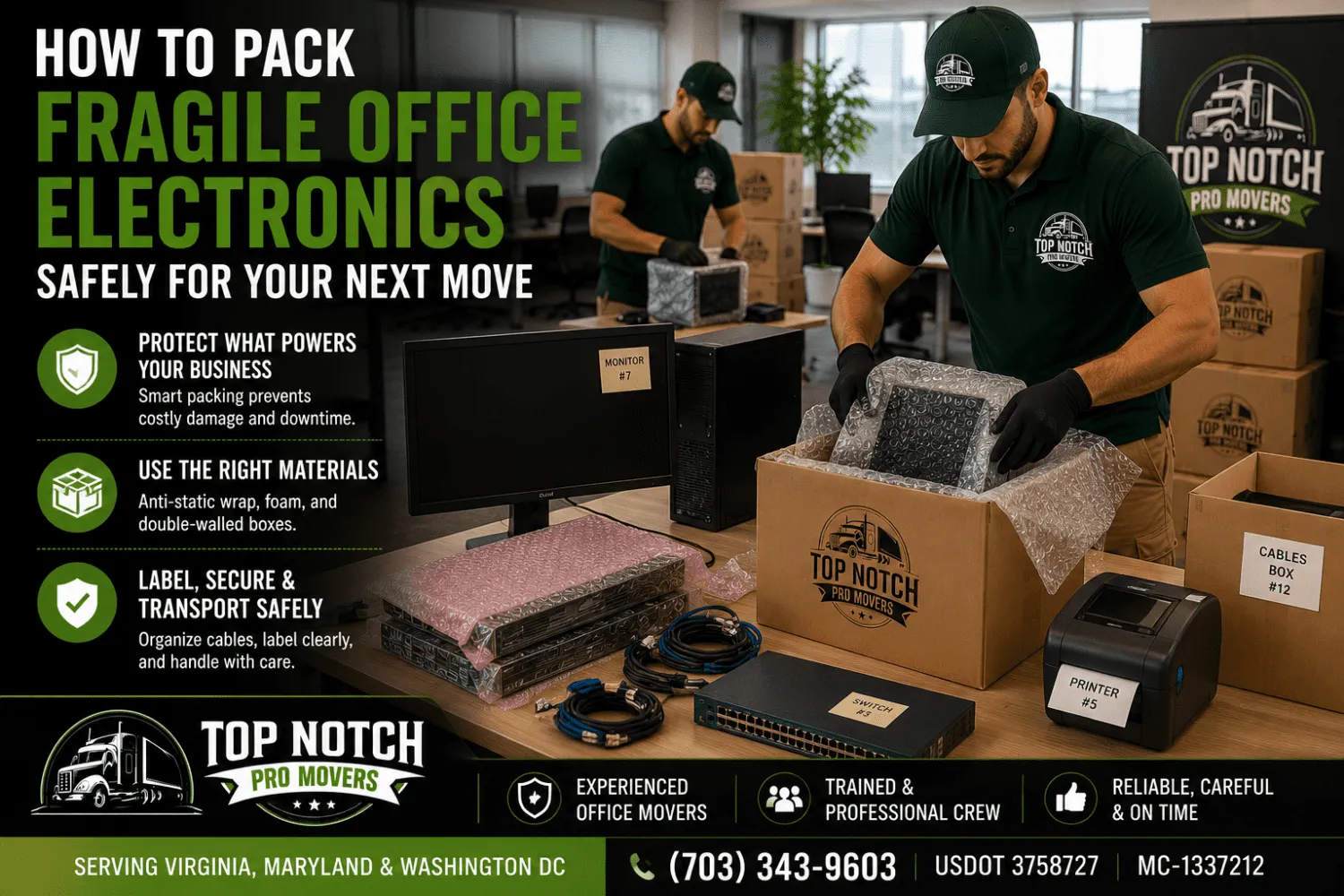
Data security is a legal necessity under modern compliance regulations. Your prospective moving firm must explain their protocol for packing, loading, and tracking data servers, hard drives, and physical personnel files. Ask if they utilize specialized anti-static wrap, climate-controlled transport vehicles, and background-checked moving personnel who are cleared to handle confidential materials.
5. Can You Provide a Fully Binding Estimate?
Hidden costs can easily destroy a corporate moving budget. To avoid unexpected surprises on delivery day, ask for a binding estimate or a binding-not-to-exceed estimate based on a comprehensive on-site or detailed virtual walkthrough. Avoid companies that only provide rough phone estimates, as these are highly susceptible to sudden post-move adjustments, fuel surcharges, and hidden access fees.
Understanding Commercial Shifting Packages
To give you a better framework for evaluating vendors like Top Notch Pro Movers alongside alternative options, it helps to analyze how different moving setups impact your operational workflows. The table below highlights the crucial differences in service delivery structures across the industry:
| Service Metric | Standard Moving Services | Premium Commercial Specialists |
| Scheduling Options | Standard daytime business hours only | 24/7 flexibility, nights, weekends, holidays |
| IT Logistics Capability | Basic loading of disconnected hardware | Disconnection, tech-crating, anti-static packing |
| Project Management | Self-managed by the client organization | Dedicated corporate relocation managers assigned |
| COI Provisioning | Often charges extra or requires delay | Standard, immediate delivery to building managers |
| Asset Tracking | Basic inventory log sheets | Digital asset tagging and itemized manifests |
6. What Logistics Equipment and Fleet Assets Do You Control?
An office shift often involves heavy machinery, expansive conference tables, and fragile electronics. Ensure that the moving company in Virginia owns a fleet of clean, modern moving trucks equipped with hydraulic lift gates, air-ride suspension (to protect delicate servers), and specialized structural dollies. Relying on sub-contracted equipment or rental box trucks often signals a lack of professional infrastructure.
7. Who Manages the On-Site Coordination on Move Day?
A chaotic move day can quickly derail your operational timeline. A reputable vendor like Top Notch Pro Movers will always assign a dedicated Project Manager or On-Site Foreperson to oversee the entire relocation process. This single point of contact coordinates with your internal transition committee, manages the moving crews, resolves unexpected building access issues, and ensures everything goes according to schedule.
Frequently Asked Questions (FAQs)
Q1: How early should our company begin planning a commercial office relocation in Virginia?
A: For small offices (under 2,000 sq. ft.), planning should ideally begin at least 2 to 3 months in advance. For mid-sized to larger corporate facilities, a window of 4 to 6 months is highly recommended to secure appropriate permits, clear building management requirements, and finalize IT infrastructure logistics layouts.
Q2: Are moving companies in Virginia legally required to be licensed for office shifting? A: Yes. For local moves within Virginia, movers must be registered with the Virginia Department of Motor Vehicles (VA DMV). If your office relocation requires crossing state borders (e.g., moving from Northern Virginia into Washington D.C. or Maryland), the company must possess an active USDOT number and operating authority from the Federal Motor Carrier Safety Administration (FMCSA).
Q3: What is a Certificate of Insurance (COI), and why does our office building require it? A: A COI is a formal document issued by an insurance company verifying that the moving business holds sufficient property damage and liability insurance coverage. Most commercial property managers strictly mandate a COI before allowing any moving crews to operate on their premises, protecting the building structures from potential accidental damage.
Q4: How should our business handle sensitive or highly confidential employee and client paperwork?
A: Highly confidential files should ideally be packed into secure, lockable plastic moving crates. You should discuss chain-of-custody protocols with your relocation specialist. For high-security sectors, businesses sometimes opt to transport extremely sensitive physical records under internal employee supervision while letting professional movers handle general workstations.
Q5: Do commercial movers handle the disassembly and reassembly of complex modular cubicles?
A: Experienced commercial relocation providers do offer modular furniture installation services. It is essential to confirm this service explicitly during your walkthrough, as system furniture disassembly requires specialized tools and technical expertise to rebuild properly at your destination office.
Final Thoughts
Relocating your business premises does not have to be an overwhelming source of corporate anxiety. By asking the right operational questions early in your vendor search, you can confidently separate standard residential movers from high-performing commercial shifting partners. Investing time in vetting your moving company ensures your business assets remain secure, your financial liability is managed, and your team is back to productive operations with minimal structural disruption.